Tuesday, September 27, 2011
東北地方太平洋沖地震震源海域に大きな亀裂を確認
jamstecchannel さんが 2011/08/15 にアップロード
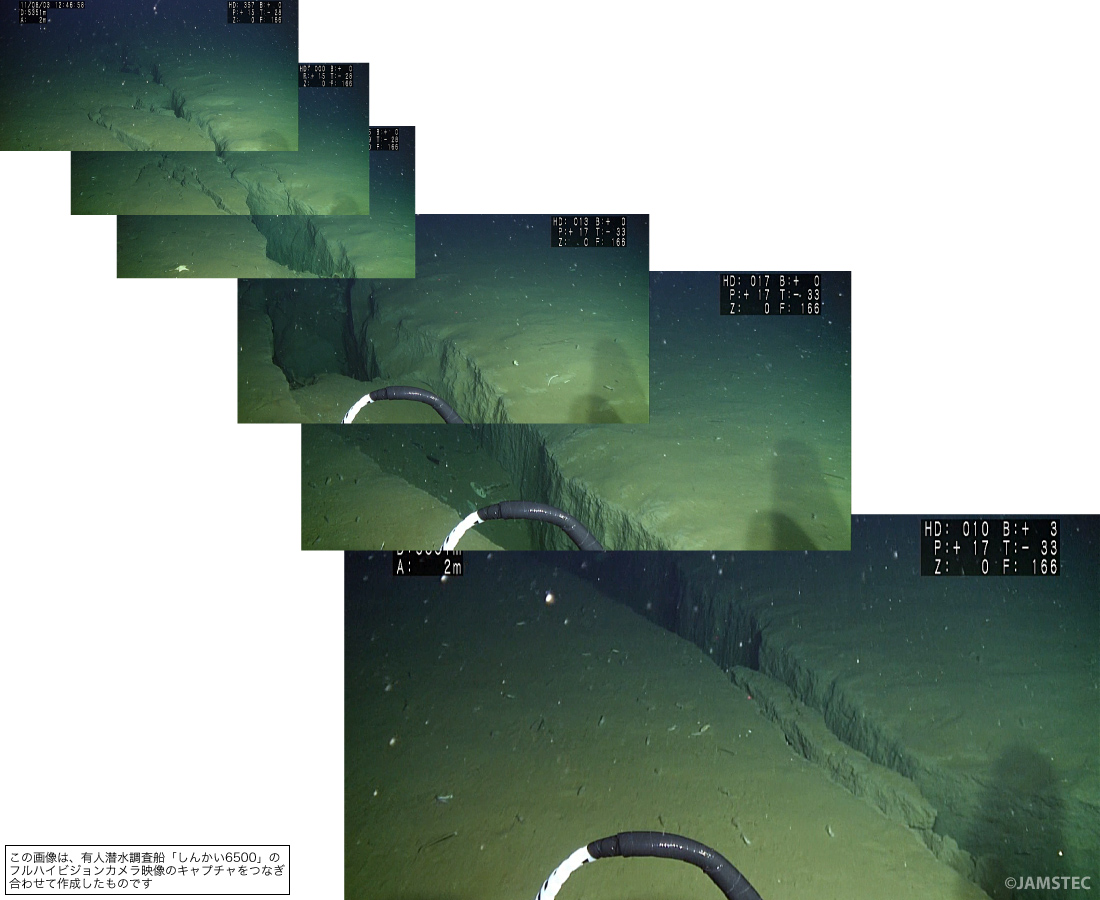
2011年8月3日、JAMSTECの有人潜水調査船「しんかい6500」は東北地方太平洋沖地震の震源海域である、日本海溝水深5350mに潜航し、巨大地震の影響と思われる大きな亀裂を確認した。
潜航海域は、北緯39度07分、東経143度53分。
「しんかい6500」が撮影した海底の亀裂。亀裂は広範囲にわたり潜航中にそのすべての姿を確認しきることはできなかった。同地点は水深が5000mを超える大深度であることから、今後も「しんかい6500」や「かいこう7000-II」を用いて調査を進めていく予定だ。
亀裂の全景写真はこちら(映像キャプチャをつなぎ合わせて作成)
http://www.jamstec.go.jp/j/jamstec_news/20110816/img/zenkei.jpg
>プレスリリース(2011年8月15日発表)
東北地方太平洋沖地震震源海域での有人潜水調査船「しんかい6500」による潜航調査で得られた画像について(速報)
http://www.jamstec.go.jp/j/about/press_release/20110815/
>「しんかい6500」夏休みスペシャル
http://www.jamstec.go.jp/j/jamstec_news/2011summer/?yt=3
8月20日(土)、JAMSTEC横浜研究所で「夏休みスペシャルデー」を開催。
特別セミナーは下記2題。
(1)【「しんかい6500」のパイロット】
「しんかい6500」の元パイロットが、自らが見てきた深海の世界、そして今後の日本の深海調査の展望について熱く語ります。
(2)【暗黒の生態系にとっての1000年に1度の大地震とは】
「しんかい6500」で東北地方太平洋沖地震の震源海域の調査を行い、下船後すぐの貴重な感想を皆様に披露します。
カテゴリ:
科学と技術
タグ:
JAMSTEC
海洋研究開発機構
しんかい6500
地震
東北地方太平洋沖地震
日本海溝
亀裂
ライセンス:
標準の YouTube ライセンス
==============================
http://www.jamstec.go.jp/j/jamstec_news/20110816/?jn
JAMSTEC
東北地方太平洋沖地震震源海域に大きな亀裂を確認
(「しんかい6500」が撮影した海底の亀裂の映像)
http://www.youtube.com/watch?feature=player_embedded&v=ZAidW9t6f9Q
http://www.jamstec.go.jp/j/jamstec_news/20110816/?jn
2011年8月3日、JAMSTECの有人潜水調査船「しんかい6500」は東北地方太平洋沖地震の震源海域である、日本海溝水深5350mに潜航し、巨大地震の影響と思われる大きな亀裂を確認した。
潜航海域は、北緯39度07分、東経143度53分。
「しんかい6500」が撮影した海底の亀裂。亀裂は広範囲にわたり潜航中にそのすべての姿を確認しきることはできなかった。同地点は水深が5000mを超える大深度であることから、今後も「しんかい6500」や「かいこう7000-II」を用いて調査を進めていく予定だ。
亀裂の全景写真はこちら
(映像キャプチャをつなぎ合わせて作成)
プレスリリース(2011年8月15日発表)
東北地方太平洋沖地震震源海域での有人潜水調査船「しんかい6500」による潜航調査で得られた画像について(速報)
Copyright 2007 Japan Agency for Marine-Earth Science and Technology


【Let's Create Future with Hope】
Let's make Peaceful and Hopeful World for Sustainable Future.
Let's make “Offshore Structure such as Noah's Ark”.
Anti-nuclear power
世界の人口増大にともなって、生まれてくる食料問題が世界的な大きな課題となってきた。中国やインド、アジア・アフリカ諸国等の人口増大に伴って、食料資源や産業用の鉱物資源の争奪・獲得競争の激化による国際紛争の多発が予想ではなくなり、現実に、我々の生活に、影響を与え始めてきている。
私達は、我々の子々孫々のために、希望のある平和の世界を築いていかなければならない。
世界の人口増大に対応し、新しい産業や産業労働市場や雇用分野の開発・増大、自然再生循環系(sustainable)の経済・社会体制を築いていかなければならないでしょう。
私達は、地球の表面積の約70%を占める海域を有効に利用して、大型浮体式海洋構造物を大規模で活用することによって、海上での農業・畜産業を発展させることができる時代を迎えている。
私達は、海洋を有効利用して、海洋牧場を展開したり、海洋資源(海洋生物、海底の鉱物)等を獲得する方法を発展させて、社会的な利益を得ることができるような時代に位地している。
現代は、世界の平和の秩序の中で安寧のある世界を実現して構築することができるような時代になってきている。
例えば洋上風力発電・洋上太陽光発電等の新産業の育成や新しい雇用創出・増大を目的として、新しい海洋開発事業・産業を創生し、確固たる平和創生の理念に基づく新しい事業・プロジェクトを推進・発展させ、世界中の青年の夢と希望を拡げながら国際的な協力を進め、安寧と希望ある未来の社会を創って行きましょう。
【プロフィールの画像は横山大観作:屈原】
Monday, September 26, 2011
New upload Tsunami video #14 Ishinomaki
YamachanUS さんが 2011/07/02 にアップロード
説明はありません
カテゴリ:
ニュースと政治
タグ:
Tsunami
video
personal
record
Japan
ライセンス:
【Let's Create Future with Hope】
Let's make Peaceful and Hopeful World for Sustainable Future.
Let's make “Offshore Structure such as Noah's Ark”.
Anti-nuclear power
世界の人口増大にともなって、生まれてくる食料問題が世界的な大きな課題となってきた。中国やインド、アジア・アフリカ諸国等の人口増大に伴って、食料資源や産業用の鉱物資源の争奪・獲得競争の激化による国際紛争の多発が予想ではなくなり、現実に、我々の生活に、影響を与え始めてきている。
私達は、我々の子々孫々のために、希望のある平和の世界を築いていかなければならない。
世界の人口増大に対応し、新しい産業や産業労働市場や雇用分野の開発・増大、自然再生循環系(sustainable)の経済・社会体制を築いていかなければならないでしょう。
私達は、地球の表面積の約70%を占める海域を有効に利用して、大型浮体式海洋構造物を大規模で活用することによって、海上での農業・畜産業を発展させることができる時代を迎えている。
私達は、海洋を有効利用して、海洋牧場を展開したり、海洋資源(海洋生物、海底の鉱物)等を獲得する方法を発展させて、社会的な利益を得ることができるような時代に位地している。
現代は、世界の平和の秩序の中で安寧のある世界を実現して構築することができるような時代になってきている。
例えば洋上風力発電・洋上太陽光発電等の新産業の育成や新しい雇用創出・増大を目的として、新しい海洋開発事業・産業を創生し、確固たる平和創生の理念に基づく新しい事業・プロジェクトを推進・発展させ、世界中の青年の夢と希望を拡げながら国際的な協力を進め、安寧と希望ある未来の社会を創って行きましょう。
【プロフィールの画像は横山大観作:屈原】
Thursday, September 15, 2011
Floating wave energy extractor, anchored to the sea bottom.
atommodel さんが 2009/04/23 にアップロード
* Floating wave energy extractor.* Anchored to the sea bottom.* A new method for tapping offshore wave energy.* Ideal for high wave offshore.* Ideal for distant offshore.* Electrolysing of sea water to generate hydrogen. * As the system is anchored, it can be installed anywhere in the offshore(far distant offshore).www.physics-edu.orgInterestingly, the both Rolls-Royce Prize for best Master's Thesis and the JEC Innovation Award in 2009 are received for almost the same concept that I have published on internet September 2004.Floating wave energy extractor published on internet in September 2004http://www.geocities.com/newideasfromtelewise/wave_energy.htmJune 2006http://www.physics-edu.org/tech/ocean_wave_power_plants.htm Rolls-Royce Prize for best Master's Thesis in 2007, and the JEC Innovation Award in 2009.http://www.ntnu.no/imt/forskning/rolls_roycehttp://www.netcomposites.com/news.asp?5372
カテゴリ:
科学と技術
タグ:
floating
wave energy
extractor
anchored
sea bottom
offshore
distant offshore
ライセンス:
標準の YouTube ライセンス
【Let's Create Future with Hope】
Let's make Peaceful and Hopeful World for Sustainable Future.
Let's make “Offshore Structure such as Noah's Ark”.
Anti-nuclear power
世界の人口増大にともなって、生まれてくる食料問題が世界的な大きな課題となってきた。中国やインド、アジア・アフリカ諸国等の人口増大に伴って、食料資源や産業用の鉱物資源の争奪・獲得競争の激化による国際紛争の多発が予想ではなくなり、現実に、我々の生活に、影響を与え始めてきている。
私達は、我々の子々孫々のために、希望のある平和の世界を築いていかなければならない。
世界の人口増大に対応し、新しい産業や産業労働市場や雇用分野の開発・増大、自然再生循環系(sustainable)の経済・社会体制を築いていかなければならないでしょう。
私達は、地球の表面積の約70%を占める海域を有効に利用して、大型浮体式海洋構造物を大規模で活用することによって、海上での農業・畜産業を発展させることができる時代を迎えている。
私達は、海洋を有効利用して、海洋牧場を展開したり、海洋資源(海洋生物、海底の鉱物)等を獲得する方法を発展させて、社会的な利益を得ることができるような時代に位地している。
現代は、世界の平和の秩序の中で安寧のある世界を実現して構築することができるような時代になってきている。
例えば洋上風力発電・洋上太陽光発電等の新産業の育成や新しい雇用創出・増大を目的として、新しい海洋開発事業・産業を創生し、確固たる平和創生の理念に基づく新しい事業・プロジェクトを推進・発展させ、世界中の青年の夢と希望を拡げながら国際的な協力を進め、安寧と希望ある未来の社会を創って行きましょう。
【プロフィールの画像は横山大観作:屈原】
Tuesday, September 13, 2011
Future Cruise Ships (2015 - 2020)
【Let's Create Future with Hope】
Let's make Peaceful and Hopeful World for Sustainable Future.
Let's make “Offshore Structure such as Noah's Ark”.
Anti-nuclear power
世界の人口増大にともなって、生まれてくる食料問題が世界的な大きな課題となってきた。中国やインド、アジア・アフリカ諸国等の人口増大に伴って、食料資源や産業用の鉱物資源の争奪・獲得競争の激化による国際紛争の多発が予想ではなくなり、現実に、我々の生活に、影響を与え始めてきている。
私達は、我々の子々孫々のために、希望のある平和の世界を築いていかなければならない。
世界の人口増大に対応し、新しい産業や産業労働市場や雇用分野の開発・増大、自然再生循環系(sustainable)の経済・社会体制を築いていかなければならないでしょう。
私達は、地球の表面積の約70%を占める海域を有効に利用して、大型浮体式海洋構造物を大規模で活用することによって、海上での農業・畜産業を発展させることができる時代を迎えている。
私達は、海洋を有効利用して、海洋牧場を展開したり、海洋資源(海洋生物、海底の鉱物)等を獲得する方法を発展させて、社会的な利益を得ることができるような時代に位地している。
現代は、世界の平和の秩序の中で安寧のある世界を実現して構築することができるような時代になってきている。
例えば洋上風力発電・洋上太陽光発電等の新産業の育成や新しい雇用創出・増大を目的として、新しい海洋開発事業・産業を創生し、確固たる平和創生の理念に基づく新しい事業・プロジェクトを推進・発展させ、世界中の青年の夢と希望を拡げながら国際的な協力を進め、安寧と希望ある未来の社会を創って行きましょう。
【プロフィールの画像は横山大観作:屈原】
Wednesday, June 8, 2011
Updated: Marine Scientists Begin Cruise Off Fukushima - ScienceInsider
From:

福島県沖の放射能測定のため17名の科学者が15日間にわたる調査に向けて出発しました。http://goo.gl/6TmAL (英語のみ)
Updated: Marine Scientists Begin Cruise Off Fukushima - ScienceInsider

Three months after the tsunami-stricken Fukushima Daiichi plant began leaking unprecedented amounts of radioactive isotopes, an interdisciplinary group of scientists will begin measuring the radioactivity in the ocean east of Japan on 4 June. Led by Ken Buesseler of Woods Hole Oceanographic Institution (WHOI), the cruise will carry 17 researchers from several countries on a 15-day expedition.
Although the greatest leaks have been capped and overall radiation levels are decreasing due to isotope decay and dilution in the ocean, measurements of the water near the plant suggest that the ocean is still picking up new radioactivity, although it's unclear whether this is coming directly from the plant, carried by rainfall, or seeping in with groundwater. Meanwhile, the water that has been pumped into the reactors to cool them is threatening to overflow its tanks in the next few days and carry radioactivity into the sea.
"We need to trace where the radionuclides are going, and how much is making it offshore," says Steven Jayne, a physical oceanographer from WHOI. The research vessel, Kaimikai‑O‑Kanoloa, will monitor radiation levels over 400 square km, crisscrossing the strong Kuroshio Current that runs northward along the east coast of Japan. The radiation spill, Jayne says, also provides a unique way of tracing the Japanese currents. "It's like pouring dye into the ocean," he says. The Kuroshio Current, similar to the Gulf Stream of the Atlantic, is a crucial factor in fish migration patterns and can slow or speed international shipping in the Pacific Ocean.
The WHOI group will monitor water 300 km offshore, an area with large fisheries for tuna and other seafood.
By the time the water reaches this area and is taken up into seafood, radioactivity is probably well diluted below what is probably dangerous for human consumption, but marine biologist Nicholas Fisher of Stony Brook University in New York says that the study will be a useful baseline to understand how radiation is dispersed in the specific ocean patterns and sea life of the Pacific.
Fisher is leading the effort to study how marine life takes up radionuclides into its tissues. Because 3 months have passed and most isotopes, particularly the short-lived iodine-131 with an 8-day half-life, have decayed considerably, he doesn't expect to see any toxicity. However, there will still be detectable levels in organisms such as brown seaweed, which can store iodine at 10,000 times the concentration in the water. Such a measure might help researchers understand how the isotopes move through the food chain, even up to seafood-eating humans.
Meanwhile, Japanese researchers continue to keep a close eye on the water close to the plant. Calculations by the French Institute for Radiological Protection and Nuclear Safety (IRSN) in Cherbourg have calculated that, close to the Fukushima plant, there is a risk of harm to marine life, particularly to animals born in the spring. Fisher hopes that by directly field-testing the water in the area, more precise measurements can be added to their calculations.
*Update, 3 June: In an interview last night with ScienceInsider, expedition lead investigator Buesseler explained that in addition to the well-known isotopes iodine-131 and cesium-137, the cruise will measure the spread and bioaccumulation of rarer isotopes such as plutonium, strontium, and tritium, about which little is known. The extensive data set he expects to gather could take up to a year to analyze.
It's hard to say, Buesseler says, what impact on the marine environment this overflow would have, but his crew will be there at the right time to measure a baseline. The expected overflow of cooling water from the plant, atomic energy researchers report today, could be as serious as the meltdown itself due to the estimated 720,000 terabecquerels of radiation in it. (By comparison, 630,000 terabecquerels of radiation were released into the atmosphere as of 15 April.)
While lauding the ongoing efforts by TEPCO and Japanese researchers to study the levels offshore, "no one country can do everything," says Buesseler. The WHOI cruise, he adds, which includes researchers from the International Atomic Energy Agency and multiple nations, "can build public confidence in data quality" and build a "broad, common data set" that will be extremely useful for marine scientists studying radiation in the future.
Fisher is leading the effort to study how marine life takes up radionuclides into its tissues. Because 3 months have passed and most isotopes, particularly the short-lived iodine-131 with an 8-day half-life, have decayed considerably, he doesn't expect to see any toxicity. However, there will still be detectable levels in organisms such as brown seaweed, which can store iodine at 10,000 times the concentration in the water. Such a measure might help researchers understand how the isotopes move through the food chain, even up to seafood-eating humans.
Meanwhile, Japanese researchers continue to keep a close eye on the water close to the plant. Calculations by the French Institute for Radiological Protection and Nuclear Safety (IRSN) in Cherbourg have calculated that, close to the Fukushima plant, there is a risk of harm to marine life, particularly to animals born in the spring. Fisher hopes that by directly field-testing the water in the area, more precise measurements can be added to their calculations.
*Update, 3 June: In an interview last night with ScienceInsider, expedition lead investigator Buesseler explained that in addition to the well-known isotopes iodine-131 and cesium-137, the cruise will measure the spread and bioaccumulation of rarer isotopes such as plutonium, strontium, and tritium, about which little is known. The extensive data set he expects to gather could take up to a year to analyze.
It's hard to say, Buesseler says, what impact on the marine environment this overflow would have, but his crew will be there at the right time to measure a baseline. The expected overflow of cooling water from the plant, atomic energy researchers report today, could be as serious as the meltdown itself due to the estimated 720,000 terabecquerels of radiation in it. (By comparison, 630,000 terabecquerels of radiation were released into the atmosphere as of 15 April.)
While lauding the ongoing efforts by TEPCO and Japanese researchers to study the levels offshore, "no one country can do everything," says Buesseler. The WHOI cruise, he adds, which includes researchers from the International Atomic Energy Agency and multiple nations, "can build public confidence in data quality" and build a "broad, common data set" that will be extremely useful for marine scientists studying radiation in the future.
【Let's Create Future with Hope】
Let's make Peaceful and Hopeful World for Sustainable Future.
Let's make “Offshore Structure such as Noah's Ark”.
Anti-nuclear power
世界の人口増大にともなって、生まれてくる食料問題が世界的な大きな課題となってきた。中国やインド、アジア・アフリカ諸国等の人口増大に伴って、食料資源や産業用の鉱物資源の争奪・獲得競争の激化による国際紛争の多発が予想ではなくなり、現実に、我々の生活に、影響を与え始めてきている。
私達は、我々の子々孫々のために、希望のある平和の世界を築いていかなければならない。
世界の人口増大に対応し、新しい産業や産業労働市場や雇用分野の開発・増大、自然再生循環系(sustainable)の経済・社会体制を築いていかなければならないでしょう。
私達は、地球の表面積の約70%を占める海域を有効に利用して、大型浮体式海洋構造物を大規模で活用することによって、海上での農業・畜産業を発展させることができる時代を迎えている。
私達は、海洋を有効利用して、海洋牧場を展開したり、海洋資源(海洋生物、海底の鉱物)等を獲得する方法を発展させて、社会的な利益を得ることができるような時代に位地している。
現代は、世界の平和の秩序の中で安寧のある世界を実現して構築することができるような時代になってきている。
例えば洋上風力発電・洋上太陽光発電等の新産業の育成や新しい雇用創出・増大を目的として、新しい海洋開発事業・産業を創生し、確固たる平和創生の理念に基づく新しい事業・プロジェクトを推進・発展させ、世界中の青年の夢と希望を拡げながら国際的な協力を進め、安寧と希望ある未来の社会を創って行きましょう。
【プロフィールの画像は横山大観作:屈原】
Subscribe to:
Posts (Atom)