ノアの箱舟を創ろう Let us Create the Super Ocean-Floating-Structures such as the Noah's ark.

ノアの箱舟を創ろう Let us Create the Super Ocean - Floating - Structures such as the Noah's ark.

Wednesday, October 10, 2012

$ヤマト姫の玉手箱

http://inhabitat.com/aquamarine-power-to-connect-wave-energy-generator-to-uk-national-grid/

Energy

$ヤマト姫の玉手箱 Aquamarine Power To Connect Wave Energy Generator To UK National Grid

by Hazel Saunderson, 02/15/12
filed under: green technology, News, Renewable Energy

$ヤマト姫の玉手箱


Scotland may be a small country, but its stake in the future renewable energy is about to get serious as Aquamarine Power’s Oyster 800 Wave energy device will soon be installed and connected to the UK grid. We covered the launch of this innovative “near shore” Oyster 800 device last year, and earlier this week Scotland’s Energy Minister Fergus Ewing granted full consent to developments of the 2.4MW wave energy demonstration project. This consent means two further Oyster 800 wave energy devices will be installed at the same site at the European Marine Energy Centre (EMEC) in Orkney, and this will create the UK’s first grid-connected near shore wave power array with a total of three 800kW Oyster devices.

$ヤマト姫の玉手箱


Consents play a vital part in the development of such projects, and this consent should pave the way for Aquamarine Power to continue to work with Marine Scotland and gain all the necessary consents for their other sites — a 200MW commercial wave energy site in Orkney, and a 40MW site on Lewis.

Scotland’s Energy Minster Fergus Ewing said of the project:
“Scotland has unparalleled natural resources, with a tenth of Europe’s wave power, and these new devices will help us to fully harness the huge energy resources around our own coast and contribute to global efforts to expand clean, green electricity generation… it is innovation and creativity such as that behind the Oyster device which will help us meet our ambitious renewable electricity targets and help us reindustrialize Scotland.”

Aquamarine Power stated:
“Our application has been granted subject to the implementation of a suitable environmental monitoring and mitigation plan to ensure suitable measures are taken to protect the environment. We look forward to working with the local community in Orkney on the responsible development of our first Oyster array.

“This is a great milestone for our company and for the wave energy industry as a whole. This marks an important step in the development of Oyster which one day will be delivering power to hundreds of thousands of homes.”

We look forward to seeing what the new technology will mean for the UK, and in the long run, what it could mean for other nations.

+ Aquamarine Power

+ Marine Scotland

+ European Marine Energy Centre (EMEC)

Images ©Aquamarine Power

© Inhabitat.com 2012

===================================================================

http://inhabitat.com/aquamarine-power-unveils-oyster-800-wave-energy-generator-exclusive-photos/

Aquamarine Power Unveils Oyster 800 Wave Energy Generator - Exclusive Photos!

by Hazel Saunderson, 07/17/11

$ヤマト姫の玉手箱


This morning Scottish First Minister Alex Salmond heralded a landmark achievement in renewable energy technology as he unveiled Aquamarine Power's new Oyster 800 wave energy generator at the Burntisland Fabrications yard - and Inhabitat was on the scene to bring you an exclusive first look! This impressive device can generate 250% more power at one third the cost of the first full-scale 315kw Oyster that was installed in Orkney in 2009. Martin McAdam, Chief Executive Officer of Aquamarine Power commented: "A farm of just 20 Oyster 800 devices would generate sufficient power for up to 15,000 homes. There are often waves when there is no wind and marine energy offers an essential part of Scotland's future low carbon energy mix." Read on to learn more and check out our exclusive photos!

Read more:
http://inhabitat.com/aquamarine-power-unveils-oyster-800-wave-energy-generator-exclusive-photos/oyster-800-wave-energy-generator-3/?extend=1

Scotland is renowned for its magnificent coastlines and delicious seafood - however, the latest denizen of the deep captured our attention for an entirely different reason - its ability to capture wave energy. The Oyster 800 operates in the same way as Oyster 1, but Aquamarine Power has used data and lessons learned from the first Oyster to significantly improve its power output, simplify installation and allow for easier maintenance.

$ヤマト姫の玉手箱


© Inhabitat.com 2012

===================================================================

参考リンク

youtube 検索 : Marine Energy Conference in Inverness

£18 million marine energy fund


scottishgovernmentさんが 2012/05/23 に公開

A multi-million pound fund to help develop Scotland's first commercial wave and tidal power arrays was opened today. Addressing the AllEnergy conference in Aberdeen, First Minister Alex Salmond announced that Scotland's Marine Renewables Commercialisation Fund (MRCF) was now open for bids by marine energy developers.

He also announced the first award from the £70 million National Renewables Infrastructure Fund (N-RIF) -- a £500,000 grant to support the transformation of a strategic dock, ten miles from Glasgow city centre to create a key manufacturing location for renewable energy.

http://www.youtube.com/user/scottishgovernment

The Scottish Government について

The Scottish Government is responsible for most of the issues of day-to-day concern to the people of Scotland, including health, education, justice, rural affairs, and transport.

======================================

参考リンク

Alex Salmond to promote Scotland in California

http://throughmyspecs.co.uk/2012/06/04/alex-salmond-to-promote-scotland-in-california/

$ヤマト姫の玉手箱

Posted by Steven Stewart on Monday, June 4, 2012·

First Minister Alex Salmond is to visit California this month in an effort to build on economic links and encourage inward investment in Scotland.

Mr Salmond will undertake a series of engagements in Los Angeles, Sacramento and San Francisco which will focus on innovation, tourism and jobs.

During the four-day trip, he will meet US politicians and business leaders.

Mr Salmond will also attend the world premiere of the animated film Brave, which has a mythical Scottish setting.

The Scottish government estimates that the Disney/Pixar film, which is due to open at the Los Angeles Film Festival, could boost the Scottish economy by £140m.

The premiere will bring together Disney/Pixar and tourism agency VisitScotland, who are collaborating on a global marketing campaign to showcase Scotland across the world.

Inward investment

The first minister will then travel to Sacramento, where he will outline to US politicians the importance to the Scottish economy of sustained investment by global California-based corporations.

Mr Salmond will also promote Scotland’s record in attracting investment from US and major global companies in a speech to the Commonwealth Club of California in San Francisco.

Business visits will include a trip to Stanford University to see the work of the SU2P, a venture between Stanford and Strathclyde, Heriot-Watt, St Andrews and Glasgow universities which is designed to capitalise on leading research in the photonics sector.

The first minister said: “Scottish companies are operating in a highly competitive global economy, and the Scottish government and our agencies are using every opportunity available to boost investment, tourism, and jobs.

“The US offers huge potential, and Scotland and Scottish companies are ideally placed to take advantage of the outstanding opportunities that are available.

“This visit will help us identify and enhance the opportunities for real, practical innovation and collaboration, and bring investment and jobs to Scotland.”

Source: http://www.bbc.co.uk/news/uk-scotland-scotland-business-18308335

Copyright 2012 The World Through My Specs

===================================================================

参考リンク

Alex Salmond :Wikipedia

http://en.wikipedia.org/wiki/Alex_Salmond

以下抜粋

Alexander Elliot Anderson Salmond ( born 31 December 1954) is a Scottish politician and current First Minister of Scotland. He became Scotland's fourth First Minister in May 2007. He is the Leader of the Scottish National Party (SNP), having served as Member of the Scottish Parliament (MSP) for Gordon. From 1987 to 2010 he served as Member of Parliament for Banff and Buchan in the House of Commons of the United Kingdom. Salmond previously held the position of leader of the SNP from September 1990 until he stepped down in September 2000.

Originally from Linlithgow, West Lothian, Salmond is a graduate of the University of St Andrews, where he achieved a Joint Honours MA in Economics and History. After earning his degree he began his career in the Government Economic Service (GES), and later joined the Royal Bank of Scotland as an energy economist where he wrote and broadcast extensively for both domestic and international media outlets.

Following the establishment of the devolved Scottish Parliament in 1999, he was elected MSP for Banff and Buchan, thus simultaneously representing the area as both Member of Parliament (MP) and MSP. Salmond resigned as SNP leader in 2000 and did not seek re-election to the Scottish Parliament. He did however retain his Westminster seat in the 2001 general election. Salmond was once again elected SNP leader in 2004 and the following year held his Banff and Buchan seat in the 2005 general election. In 2006 he announced his intention to contest the Gordon constituency in the 2007 Scottish Parliament election, an election in which Salmond defeated the incumbent MSP and in which nationally, the SNP emerged as the largest single party. Salmond was voted First Minister by the Scottish Parliament on 16 May 2007.

As First Minister, from 2007 to 2011 Salmond headed a minority Scottish Government, but after the 2011 Scottish Parliament election the Scottish National Party, which he leads, emerged with an overall majority. Politically, Salmond is one of the foremost proponents of Scottish independence, repeatedly calling for a referendum on the issue. Salmond has campaigned on global warming and in government has committed Scotland to legislation on emission reduction and the generation of renewable energy.

$ヤマト姫の玉手箱


Scottish cabinet.

Although energy is mostly a matter reserved to Westminster, administrative devolution of Sections 36 & 37 of the Electricity Act coupled with fully devolved planning powers enabled the Scottish Government to establish Scotland as a leader in renewable energy developments.

Other recurring campaign themes include nuclear disarmament and Salmond's strong opposition to the 2003 invasion of Iraq. Foreign policy, defence, national security and nuclear weaponry are reserved to Westminster.

Early life and careerSalmond was born at Linlithgow, West Lothian, Scotland on 31 December, (Hogmanay) 1954.[2] He is the second of four children born to Robert Fyfe Findlay Salmond and Mary Stewart Salmond (née Milne), both of whom were Civil Servants.[3] His father's family had been previously resident at Waterfoot, near Keswick.[4][5] His middle names come from his family's tradition of naming their children after the local Church of Scotland minister, in this case the Reverend G. Elliot Anderson of St Ninian's Craigmailen Parish Church in Linlinthgow.[6][7]

Salmond attended the local Linlithgow Academy before studying at the University of St Andrews, where he lived in St Salvator's Hall and graduated with a Joint Honours MA in Economics and History.[8]

In 1978 he entered the Government Economic Service as an Assistant Economist in the Department of Agriculture and Fisheries for Scotland, part of the now defunct Scottish Office. Two years later he joined the Royal Bank of Scotland where he worked for seven years: first as an Assistant Economist before being appointed Oil Economist in 1982, and from 1984 combining that role with duties as a bank economist.[8] While with the Royal Bank, he wrote and broadcast extensively for both domestic and international outlets. He also contributed regularly to oil and energy conferences. In 1983 Salmond created a "Royal Bank/BBC oil index" that is still used.

First Minister

Scottish cabinet.Having won more seats than any other party in the 2007 Scottish Parliament election, the SNP initially approached the Scottish Liberal Democrats to form a coalition, but they declined to take part in negotiations.[23] This left the SNP without any possibility to form a coalition with an overall majority. The Scottish Green Party agreed to support an SNP minority administration on a confidence and supply basis.[24]

Renewable energy

Alex Salmond in his 2010 New Year message highlighted the importance of sustainable development and renewable energy in Scotland and the required increase in powers of the Scottish Parliament needed to help harness Scotland's green energy potential and therefore take full advantage of the "renewable revolution".[35]

Earlier in December 2009, he campaigned for climate change legislation at the UN Climate Change Conference in Copenhagen to promote Scotland's role in tackling and mitigating climate change. This included signing a Partnership Agreement with the Maldives, one of the most exposed countries to the consequences of rising sea levels.[36][37]

This page was last modified on 22 September 2012 at 22:47.

===================================================================

参考リンク

Oyster 800 wave energy converter from the air


aquamarinepowerltdさんが 2011/07/28 にアップロード

This film of the Oyster 800 wave energy converter was shot at the fabrication yard in Methil, Scotland where the device was manufactured. Oyster 800 will be installed at sea in Orkney in summer 2011. The footage was shot by Cyberhawk Innovations.

===================================================================

参考リンク

New Oyster wave device


scottishgovernmentさんが 2011/07/14 にアップロード

Wave energy developer Aquamarine Power today revealed the latest in leading edge hydro electric wave energy technology.

===================================================================

===================================================================

参考リンク

European Marine Energy Centre (EMEC)

http://www.emec.org.uk/

===================================================================

参考リンク

$ヤマト姫の玉手箱


http://www.emec.org.uk/about-us/our-tidal-clients/andritz-hydro-hammerfest/

You are here: Home / About us / Tidal clients / ANDRITZ HYDRO Hammerfest

ANDRITZ HYDRO Hammerfest

ANDRITZ HYDRO Hammerfest delivers tidal turbine arrays and services to harness the great energy potential from tidal streams. The modular solutions are designed to allow optimal integration in the daily operation plans of the customers, supporting the worldwide energy mix.

The Company was established in 1997 in Hammerfest, Norway and the UK office was opened in Glasgow in 2008 in order to serve the promising local market potential. Today, ANDRITZ HYDRO Hammerfest is part of the ANDRITZ HYDRO GmbH group, a global supplier of electro-mechanical equipment and services for the hydropower business.

In December 2011, ANDRITZ HYDRO Hammerfest successfully deployed its 1 megawatt (MW) pre-commercial tidal turbine destined to validate the technology for future tidal power arrays. The machine was installed at the European Marine Energy Centre (EMEC) in December 2011 and delivered its first energy to the grid in February 2012.

The new HS1000 turbine is based on the technology of a smaller turbine, the HS300, which was installed in Norway as the first ever tidal current turbine with permanent connection to the public grid in 2004. The prototype has been in operation for more than 17,000 hours, delivering over 1.5 GWh to the grid and showed 98% availability during testing.

For more information, please visit the homepage of ANDRITZ HYDRO Hammerfest:

www.hammerfeststrom.com, www.andritz.com http://www.andritz.com/hydro.htm

Andritz Hydro Hammerfest.mp4


Copyright © 2012 · All Rights Reserved · EMEC: European Marine Energy Centre

===================================================================

参考リンク

Global Tidal Energy Part 1


RedOrkneyさんが 2010/11/30 にアップロード

Scotland is now at the epicenter of the Global tidal power renewable energy revolution.

( Filmed and edited by Kevin Burns)

This video highlights the global potential of tidal energy, Scotland's leading role in tidal power development and reviews some of the technical, environmental and social challenges facing the tidal power developers.

For further details, please visit,

http://www.hammerfeststrom.com/

http://www.atlantisresourcescorporation.com/

http://www.emec.org.uk/index.asp

http://www.openhydro.com/home.html

http://www.thecrownestate.co.uk/

http://www.scotland.gov.uk/Home

http://www.scotland.gov.uk/About/Directorates/Wealthier-and-Fairer/marine-sco...

http://www.sserenewables.com/what-we-do/marine/

http://www.icit.hw.ac.uk/

Global Tidal Energy Part2


===================================================================

参考リンク

Wave devices

You are here: Home / Marine Energy / Wave devices

http://www.emec.org.uk/marine-energy/wave-devices/

Waves have the potential to provide a completely sustainable source of energy, which can be captured and converted into electricity by wave energy converter (WEC) machines. These WECs have been developed to extract energy from shoreline out to the deeper waters offshore.

We have identified eight main types of WEC:

Copyright © 2012 · All Rights Reserved · EMEC: European Marine Energy Centre

===================================================================

参考リンク

Tidal devices

http://www.emec.org.uk/marine-energy/tidal-devices/

You are here: Home / Marine Energy / Tidal devices

Tidal devices

Tidal energy exploits the natural ebb and flow of coastal tidal waters caused principally by the interaction of the gravitational fields of the earth, moon and sun. The fast sea currents are often magnified by topographical features, such as headlands, inlets and straits, or by the shape of the seabed when water is forced through narrow channels. The tidal stream devices, which utilise these currents, are broadly similar to submerged wind turbines and are used to exploit the kinetic energy in tidal currents. Due to the higher density of water, this means that the blades can be smaller and turn more slowly, but they still deliver a significant amount of power. To increase the flow and power output from the turbine, concentrators (or shrouds) may be used around the blades to streamline and concentrate the flow towards the rotors.

We have identified six main types of Tidal Energy Convertors (TEC):

Copyright © 2012 · All Rights Reserved · EMEC: European Marine Energy Centre

====================================================================

http://www.aquamarinepower.com/news/pentland-firth-and-orkney-wave-and-tidal-charges-hit-£100-million/

NEWS

Pentland Firth and Orkney wave and tidal charges hit £100 million

18 Sep 12

New figures from Scottish Renewables have shown that island communities in Scotland's first Marine Energy Park are continuing to face massive costs to connect their marine energy projects to the grid.

Analysis, published at today's Marine Energy Conference in Inverness, reveals charges in the Pentland Firth and Orkney Waters have continued to climb, despite an independent review by Ofgem to reform the charging regime known as TNUoS (Transmission Network Use of System).

Although the review has improved matters for generators on the mainland, charges on the islands are set to rocket, adding significant costs and threatening the economic viability of wave and tidal projects that are in their early stages of development.

Speaking ahead of the Marine Energy Conference, Niall Stuart, Chief Executive of Scottish Renewables, said:

"Ofgem's review was expected to bring down charges for renewable generation given its commitment to 'facilitate the move to a low carbon energy sector'. However, we are seeing charges on the islands continue to increase, dwarfing those on the mainland.

"The level of charges for Orkney Waters is adding significant costs to wave and tidal projects and can only hold back investment in our world-leading marine energy sector."

We have to remember that our islands are where some of our best natural resources are and if we are to meet important climate change and renewable energy targets we must find a way to ensure wind, wave and tidal projects can generate electricity for homes and businesses across Scotland."

The new figures are estimated calculations based on annual grid charges for wave and tidal projects. Estimates of the projected annual connection charges for the Pentland Firth and Orkney Waters area have increased from £56m last year to £107m in 2020. This contrasts with an annual subsidy of some £2m if these projects were to be built in the south west of England - the UK's other Marine Energy Park.

While the mainland of Pentland Firth has seen a decrease of £4.6m in annual connection charges, the Orkney Waters area has seen a massive rise because electricity generators on the islands are required to pay for 'local works' which includes expensive undersea grid cabling from the Scottish mainland to the Orkney islands.

This year's estimates are also based on a larger grid cable which will be required to transport the increasing capacity of renewable electricity due to be generated in the Orkney waters from wave and tidal devices.

Aquamarine Power Chief Executive Officer Martin McAdam said:

"These new figures clearly show the methodologies employed by Ofgem and National Grid are out of step with the needs of the UK's renewable energy sector.

"With a quarter of the UK's generating capacity shutting down over the next ten years and domestic gas bills increasing 78 per cent since 2000, more than ever the UK needs a diverse renewable energy mix to secure future energy independence and to act as a hedge against fossil fuel price volatility.

"Wave energy can be a valuable part of that mix, but wave projects have to locate where the waves are - and 92 per cent of all UK wave energy projects will be subject to islands charging.

"We believe island charges are contrary to EC Directive 2009/28, Article 16(4) which states 'Member States shall ensure the charging of transmission tariffs does not discriminate against electricity from renewable energy sources produced in peripheral regions, such as island regions…'.

"The Secretary of State for Energy and Climate Change Ed Davey should step in with new measures to ensure islands charges do not jeopardise the UK's world-leading wave and tidal industry."

© Aquamarine Power 2011

All rights reserved

====================================================================

Tuesday, October 2, 2012

From: http://www.4coffshore.com/windfarms/Able-Humber-Port-pid50.html
Able Humber Port
Satellite View Of Able Humber Port. (Marker located on AMEP site)

About Able Humber Port
*** This site has recently been granted Enterprise Zone status ***

Able Marine Energy Park is a new port being developed (AMEP - southern red boundary zone on above image) offering 325 ha (803 acres) of developable land and 1500m of new deep water quays, designed specifically for the offshore wind sector. AMEP offers extensive land availability for investors to optimise their plant layout and to expand in phases as and when required. Logistics savings will be maximised through the co-location of suppliers: Blades, Towers and potentially the manufacturers of Foundations (Monopiles, Jackets and GBS structures) as well as key sub suppliers e.g. convertors, gearboxes, generators, and nacelle canopies.

Able Logistics Park (ALP - see northern red boundary zone on above image) offers a further 270 ha (667 acres) of warehousing and external storage along with a purpose built Business Park providing office facilities for engineers, consultants, OEMs, supply chain companies, developers and associated businesses. AMEP will service the needs of the Renewable Energy Sector providing a base for manufacture, storage, assembly and deployment of next generation offshore wind turbines (OWTs) and their associated supply chain(s).

AMEP benefits from the following:
•The UKs largest Enterprise Zone
•Full Enhanced Capital allowances
•Super-Fast Broadband priority
•Special Planning Zone – to expedite planning
•Business Rate Relief
•A Centre for Renewable Offshore Engineering – Identified by UK Government
•DECCs Offshore Wind Ports Infrastructure Fund – The site is suitable for applications to this fund

Location and Contact Details for Able Humber Port

Port Name
Able Humber Port
Country
United Kingdom
Port Owner
Able Humber Ports Ltd

Port Address
Rosper Road, North Killingholme, North Lincolnshire DN40 3DZ

Contact David Shepherd, Able House, Billingham Reach Industrial Estate, Billingham, Teesside TS23 1PX

Contact Telephone
+44 (0)1642-806080

Contact Fax
+44 (0)1642-655655

Email
dshepherd@ableuk.com or info@ahpl.com

Website
Visit the website for Able Humber Port

Coordinates (decimal degrees)
53.656° Lat, -0.244° Lon
Access Details for Able Humber Port

Port Depth
11 metres

Entrance Width
840 metres

Tidal Range (Springs)
6.4 metres


Maximum Vessel Size
LOA : any
Draught : 11 m
Beam : any
Tug Assistance Available?
Yes

Piloting Information
Exemption certificates can be granted for vessels above 90m. Pilotage is not required for vessels under 90m.

Turning Area Available?
Yes

Rail Links
Yes (direct access to national network and Tata Steel Plant, Scunthorpe)

Major Roads
•M180 10 miles from AHP
•M18 35 miles from AHP
•M62 42 miles from AHP
•M1 55 miles from AHP

Private Internal Road Links
Yes

Distance to Helipad
14.5 km
Distance to International Airport
14.5 km

Any Comments
Quays can be designed to provide -23.4m water depth (at MHWS).
International Airports: •Humberside Distance 14 km (15 minutes)
•Doncaster Distance 72 km (45 minutes)
•Leeds Distance 134 km (1.4 hours)
•Manchester Distance 196 km (2 hours)
•Birmingham Distance 217 km (2.1 hours)

Heliports:
Humberside Airport operates the UK’s 2nd largest Heliport.
Contact us to add your PortCapacities at Able Humber Port

Number Of Cranes
4

Crane Comments
2 x 250 tonne (lift capacity). 2 crawler cranes 1x1250 tonne (lift capacity) and 1x1600 tonne (lift capacity).

Quay Length
1,279 metres

Quay Loading Capacity
20 tonnes/m2 (Heavy load out area 40 tonnes/m2)

Quay Comments
Quay length: 1279m. Quays loads: 20 t/m2 UDL with patch loads up to 100 t/m2. Multi-user, designed specifically around the needs of the OWT industry.

Storage Space Available
647 hectares (6,474,970 m2 or 1,600 acres)

Storage Comments
Quay land storage is available

Development Land Available
647 hectares (6,474,970 m2 or 1,600 acres)

Development Land Comments
Supply Chain Capabilities and Services

Suitable Installations Base?
Yes

Suitable Operations and Maintenance Base?
Yes

Can support manufacturing of ..?
Towers : Yes Blades : Yes Foundations : Yes Cables : Yes Supplies ..? Provisions : Yes Water : Yes Fuel Oil : Yes Diesel Oil : Yes

Services
Repair, loading / unloading, decommissioning / recycling, multi-user. All supplies can be delivered by road, rail and sea.

Has Dry Dock?
No

Has Warehousing?
Yes

Security Level
TRANSEC

Additional Information & Experience
Buildings are available from 2012 with the quays becoming available late 2014.

Able is an experienced operator of multi-user port facilities and has a substantial track record of developing sites and managing large industrial based projects

If you require quay access before late 2014 please contact us to enquire about our Able Seaton Port facility.

© 2012, 4C Offshore

Tuesday, September 4, 2012

RWE Innogy: Errichtung des Offshore-Windparks Rhyl Flats

RWE Innogy: Errichtung des Offshore-Windparks Rhyl Flats RWEKonzernさんが 2010/04/12 にアップロード Seit über 10 Jahren betreibt RWE Windparks in ganz Europa. Großes Potenzial bieten Windparks auf dem offenen Meer, sogenannte Offshore-Windparks. Diese Anlagen fernab von Siedlungsgebieten erzeugen mehr Strom als Anlagen an Land, da auf hoher See die Winde stärker und gleichmäßiger wehen. (Film nur in englischer Version) カテゴリ:科学と技術

==============================================================

E.ON Climate & Renewables Eonさんが 2010/03/30 にアップロード E.ON Climate & Renewables. An overview of our most important projects - from offshore wind to solar power. カテゴリ: 科学と技術

==============================================================

洋上風力発電所の再生可能エネルギー InfineonJPさんが 2012/05/07 に公開 http://www.infineon.com/energy-efficiency - エネルギーは生活そのものです。家の暖房や車の駆動に加え、巨大都市に明かりを灯します。エネルギーに対する世界的な需要は増え続ける一方で、資源は減少しています。世界­中で消費されるエネルギーの3分の1は電気で、その傾向はさらに強まっています。将来、エネルギー源の鍵となるのがエネルギー効率です。 電気の最適な使用は、スマートな半導体技術を利用することで実現します。革新的なチップソリューションによって車、産業用プラント、民生用家電の微調整を行い、エネルギー­を抑えます。スマートメーターによってkWhの電力量を分単位の精度で評価できるようになり、電力節減が促されます。 風力エネルギーの未来は、世界中の沖合地域に見ることができます。北海やバルト海だけを見ても、今後2-3年で30もの洋上風力発電所が計画されています。 未来の電力供給網 はより効率的になります。 未来の電力供給網では、風力、太陽熱、水力を使って地元で電力を自給自足します。しかし、浮き沈みがあるのは避けられません。 スマートグリッドは、電力の供給や需要を制御することで、信頼性の高い電流の流れを確保します。 インフィニオンの革新的な半導体ソリューションを採用することで、コンセントからの電力の損失が低減されます。 パワーエレクトロニクスにより、発電所から何千キロも離れた消費者へ効率よくエネルギーが送られます。 カテゴリ: 科学と技術

Friday, June 15, 2012

Column: Is Obama grounding JFK's space legacy? - USATODAY.com

Column: Is Obama grounding JFK's space legacy? - USATODAY.com

http://usatoday30.usatoday.com/news/opinion/forum/2011-05-24-Obama-grounding-JFK-space-legacy_n.htm

By Neil Armstrong, Jim Lovell and Gene Cernan
Updated 5/24/2011 4:45 PM

"First, I believe that this nation should commit itself to achieving the goal, before this decade is out, of landing a man on the moon and returning him safely to the Earth. No single space project in this period will be more impressive to mankind, or more important for the long-range exploration of space; and none will be so difficult or expensive to accomplish."President John F. Kennedy, Joint Session of Congress, May 25, 1961

Was President Kennedy a dreamer, a visionary, or simply politically astute? We may never know, but he had the courage to make that bold proposal 50 years ago Wednesday. The Soviet Union's Yuri Gagarin had completed an orbit of the Earth the previous month and electrified the world. The United States had taken only one human, Alan Shepard, above 100 miles altitude and none into orbit. Americans, embarrassed by the successes of our Cold War adversary, were eager to demonstrate that we too were capable of great achievements in space.

President Kennedy called in the leaders of the nascent National Aeronautics and Space Administration for their opinion on any space goal that Uncle Sam could win. They concluded that the only possibility was a manned lunar landing, and that would include all the principal elements of human space travel.

The president decided this was the right project, the right time, and the Americans were the right people.

"Now it is time to take longer strides — time for a great new American enterprise — time for this nation to take a clearly leading role in space achievement, which in many ways may hold the key to our future on earth.

… Let it be clear that I am asking the Congress and the country to accept a firm commitment to a new course of action, a course which will last for many years and carry very heavy costs."

— President Kennedy

A half century has passed since Kennedy challenged our citizenry to do what most thought to be impossible. The subsequent American achievements in space were remarkable: Mercury, Gemini, Apollo and Skylab. Our efforts enhanced international cooperation with Apollo-Soyuz, the space shuttle and the International Space Station. The compelling fascination of our space achievements among young people spurred their interest in education.

By 2005, in keeping with President Kennedy's intent and America's resolve, NASA was developing the Constellation program, focusing on a return to the moon while simultaneously developing the plans and techniques to venture beyond, and eventually to Mars.

The program enjoyed near-unanimous support, being approved and endorsed by the Bush administration and by both Democratic and Republican Congresses. However, due to its congressionally authorized funding falling victim to Office of Management and Budget cuts, earmarks and other unexpected financial diversions, Constellation fell behind schedule. An administration-appointed review committee concluded the Constellation program was "not viable" due to inadequate funding.
President Obama's proposed 2011 budget did not include funds for Constellation, therefore essentially canceling the program. It sent shock waves throughout NASA, the Congress and the American people. Nearly $10 billion had been invested in design and development of the program.
Many respected experts and members of Congress voiced concern about the president's proposal. Some supported the president's plan,but most were critical. The supporters' biases were often evident, particularly when there was a vested or economic interest in the outcome.
Obama's advisers, in searching for a new and different NASA strategy with which the president could be favorably identified, ignored NASA's operational mandate and strayed widely from President Kennedy's vision and the will of the American people.
"We intend to be first. In short, our leadership in science and in industry, our hopes for peace and security, our obligations to ourselves as well as others, all require us to make this effort, to solve these mysteries, to solve them for the good of all men, and to become the world's leading space-faring nation."
— President Kennedy

Congress, realizing the devastating effects to the plans, program and morale of those trying to keep America in the forefront of exploring the universe and expanding the human frontier, worked diligently to steer NASA's program back toward Kennedy's goals.
Congress passed an authorization bill directing NASA to begin development of a large rocket capable of carrying humans toward the moon and beyond and to continue development of a multipurpose spacecraft based on the configuration that was being developed in the Constellation program. However, the president's 2012 budget reduced funding significantly below the authorized amount for both the big rocket and the multipurpose crew vehicle.
On the other hand, the president's budget had significantly increased funding over the congressional direction in the area of space technology research programs and the development of rockets and spacecraft by the commercial entrepreneurs.
Congress stated that rather than depending on NASA subsidies, the development of commercial sources to supply cargo and crew to the International Space Station should be a partnership between government and industry.
Entrepreneurs in the space transportation business assert that they can offer such service at a very attractive price — conveniently not factoring in the NASA-funded development costs. These expenditures, including funds to insure safety and reliability, can be expected to be substantially larger and more time consuming than the entrepreneurs predict.
The response to Kennedy's bold challenge a half-century ago has led to America's unchallenged leadership in space. We take enormous pride in all that has been accomplished in the past 50 years. And we have the people, the skills and the wherewithal to continue to excel and reach challenging goals in space exploration.
But today, America's leadership in space is slipping. NASA's human spaceflight program is in substantial disarray with no clear-cut mission in the offing. We will have no rockets to carry humans to low-Earth orbit and beyond for an indeterminate number of years. Congress has mandated the development of rocket launchers and spacecraft to explore the near-solar system beyond Earth orbit. But NASA has not yet announced a convincing strategy for their use. After a half-century of remarkable progress, a coherent plan for maintaining America's leadership in space exploration is no longer apparent.
 
"We have a long way to go in this space race. But this is the new ocean, and I believe that the United States must sail on it and be in a position second to none."
— President Kennedy
Kennedy launched America on that new ocean. For 50 years we explored the waters to become the leader in space exploration. Today, under the announced objectives, the voyage is over. John F. Kennedy would have been sorely disappointed.
Apollo astronauts Neil Armstrong, Jim Lovell and Gene Cernan all commanded moon missions. Armstrong was the first man to reach the lunar surface, and Cernan was the last to leave it.

For more information about reprints & permissions, visit our FAQ's. To report corrections and clarifications, contact Standards Editor Brent Jones. For publication consideration in the newspaper, send comments to letters@usatoday.com. Include name, phone number, city and state for verification. To view our corrections, go to corrections.usatoday.com.

Posted 5/24/2011 2:57:54 PM | Updated 5/24/2011 4:45 PM

© 2012 USA TODAY, a division of Gannett Co. Inc.

Sunday, May 20, 2012

Watch Inside Japan's Nuclear Meltdown on PBS. See more from FRONTLINE.

Wednesday, April 25, 2012

Transport solutions for Offshore Wind Power Plants

Green America: Ten Strikes

Green America: Ten Strikes

Wednesday, March 7, 2012

Japan debris field swirls towards Canada, U.S. West Coast (cc)

Tuesday, March 6, 2012

Chevron Offshore Australia

Tuesday, December 27, 2011

UIltimate Engineering: Super Pipeline constuction of Ormen Lange marine ...

Nord Stream_Technology

Pipelay Barge Castoro Sei in the North Sea

Off Shore Oil Rig - Oil Refinery - Drilling For Oil - Oil Rig Workers - ...

Dunbar Oil Rig in North Sea - Hit by huge wave (14-12-2008)

Tuesday, September 27, 2011

東北地方太平洋沖地震震源海域に大きな亀裂を確認


jamstecchannel さんが 2011/08/15 にアップロード

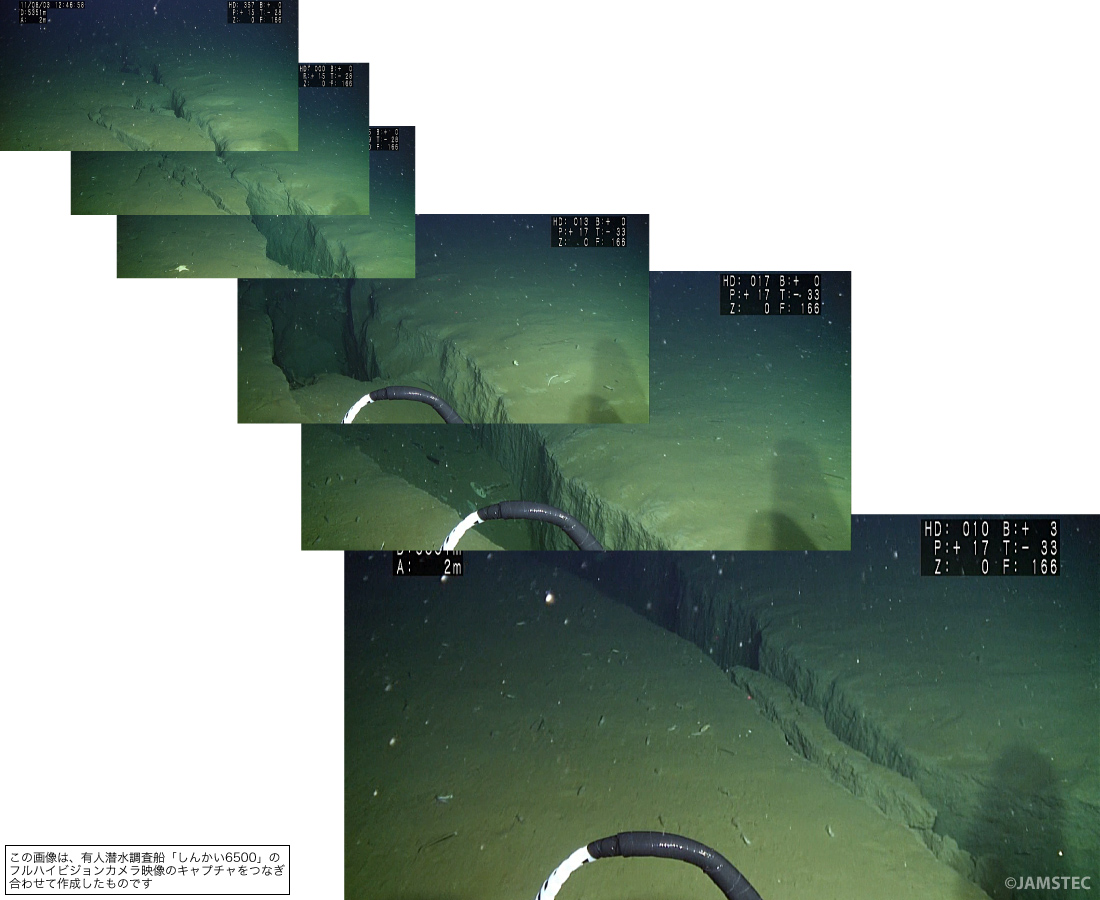
2011年8月3日、JAMSTECの有人潜水調査船「しんかい6500」は東北地方太平洋沖地震の震源海域である、日本海溝水深5350mに潜航し、巨大地震の影響と思­われる大きな亀裂を確認した。
潜航海域は、北緯39度07分、東経143度53分。
「しんかい6500」が撮影した海底の亀裂。亀裂は広範囲にわたり潜航中にそのすべての姿を確認しきることはできなかった。同地点は水深が5000mを超える大深度である­ことから、今後も「しんかい6500」や「かいこう7000-II」を用いて調査を進めていく予定だ。
亀裂の全景写真はこちら(映像キャプチャをつなぎ合わせて作成)
http://www.jamstec.go.jp/j/jamstec_news/20110816/img/zenkei.jpg

>プレスリリース(2011年8月15日発表)
東北地方太平洋沖地震震源海域での有人潜水調査船「しんかい6500」による潜航調査で得られた画像について(速報)
http://www.jamstec.go.jp/j/about/press_release/20110815/

>「しんかい6500」夏休みスペシャル
http://www.jamstec.go.jp/j/jamstec_news/2011summer/?yt=3
8月20日(土)、JAMSTEC横浜研究所で「夏休みスペシャルデー」を開催。
特別セミナーは下記2題。
(1)【「しんかい6500」のパイロット】
「しんかい6500」の元パイロットが、自らが見てきた深海の世界、そして今後の日本の深海調査の展望について熱く語ります。
(2)【暗黒の生態系にとっての1000年に1度の大地震とは】
「しんかい6500」で東北地方太平洋沖地震の震源海域の調査を行い、下船後すぐの貴重な感想を皆様に披露します。

カテゴリ:
科学と技術

タグ:
JAMSTEC
海洋研究開発機構
しんかい6500
地震
東北地方太平洋沖地震
日本海溝
亀裂

ライセンス:
標準の YouTube ライセンス

==============================

http://www.jamstec.go.jp/j/jamstec_news/20110816/?jn

JAMSTEC

東北地方太平洋沖地震震源海域に大きな亀裂を確認
(「しんかい6500」が撮影した海底の亀裂の映像)

http://www.youtube.com/watch?feature=player_embedded&v=ZAidW9t6f9Q

http://www.jamstec.go.jp/j/jamstec_news/20110816/?jn

2011年8月3日、JAMSTECの有人潜水調査船「しんかい6500」は東北地方太平洋沖地震の震源海域である、日本海溝水深5350mに潜航し、巨大地震の影響と思われる大きな亀裂を確認した。
潜航海域は、北緯39度07分、東経143度53分。
「しんかい6500」が撮影した海底の亀裂。亀裂は広範囲にわたり潜航中にそのすべての姿を確認しきることはできなかった。同地点は水深が5000mを超える大深度であることから、今後も「しんかい6500」や「かいこう7000-II」を用いて調査を進めていく予定だ。

亀裂の全景写真はこちら

(映像キャプチャをつなぎ合わせて作成)

プレスリリース(2011年8月15日発表)
東北地方太平洋沖地震震源海域での有人潜水調査船「しんかい6500」による潜航調査で得られた画像について(速報)

Copyright 2007 Japan Agency for Marine-Earth Science and Technology

Monday, September 26, 2011

New upload Tsunami video #14 Ishinomaki


さんが 2011/07/02 にアップロード
説明はありません
カテゴリ:
ニュースと政治
タグ:
Tsunami
video
personal
record
Japan
ライセンス:

Thursday, September 15, 2011

Floating wave energy extractor, anchored to the sea bottom.


さんが 2009/04/23 にアップロード
* Floating wave energy extractor.* Anchored to the sea bottom.* A new method for tapping offshore wave energy.* Ideal for high wave offshore.* Ideal for distant offshore.* Electrolysing of sea water to generate hydrogen. * As the system is anchored, it can be installed anywhere in the offshore(far distant offshore).www.physics-edu.orgInterestingly, the both Rolls-Royce Prize for best Master's Thesis and the JEC Innovation Award in 2009 are received for almost the same concept that I have published on internet September 2004.Floating wave energy extractor published on internet in September 2004http://www.geocities.com/newideasfromtelewise/wave_energy.htmJune 2006http://www.physics-edu.org/tech/ocean_wave_power_plants.htm Rolls-Royce Prize for best Master's Thesis in 2007, and the JEC Innovation Award in 2009.http://www.ntnu.no/imt/forskning/rolls_roycehttp://www.netcomposites.com/news.asp?5372
カテゴリ:
科学と技術
タグ:
floating
wave energy
extractor
anchored
sea bottom
offshore
distant offshore
ライセンス:
標準の YouTube ライセンス

Tuesday, September 13, 2011

Future Cruise Ships (2015 - 2020)

Wednesday, June 8, 2011

Updated: Marine Scientists Begin Cruise Off Fukushima - ScienceInsider

From:
John V. Roos


Updated: Marine Scientists Begin Cruise Off Fukushima - ScienceInsider


Three months after the tsunami-stricken Fukushima Daiichi plant began leaking unprecedented amounts of radioactive isotopes, an interdisciplinary group of scientists will begin measuring the radioactivity in the ocean east of Japan on 4 June. Led by Ken Buesseler of Woods Hole Oceanographic Institution (WHOI), the cruise will carry 17 researchers from several countries on a 15-day expedition.
Although the greatest leaks have been capped and overall radiation levels are decreasing due to isotope decay and dilution in the ocean, measurements of the water near the plant suggest that the ocean is still picking up new radioactivity, although it's unclear whether this is coming directly from the plant, carried by rainfall, or seeping in with groundwater. Meanwhile, the water that has been pumped into the reactors to cool them is threatening to overflow its tanks in the next few days and carry radioactivity into the sea.
"We need to trace where the radionuclides are going, and how much is making it offshore," says Steven Jayne, a physical oceanographer from WHOI. The research vessel, Kaimikai‑O‑Kanoloa, will monitor radiation levels over 400 square km, crisscrossing the strong Kuroshio Current that runs northward along the east coast of Japan. The radiation spill, Jayne says, also provides a unique way of tracing the Japanese currents. "It's like pouring dye into the ocean," he says. The Kuroshio Current, similar to the Gulf Stream of the Atlantic, is a crucial factor in fish migration patterns and can slow or speed international shipping in the Pacific Ocean.
The WHOI group will monitor water 300 km offshore, an area with large fisheries for tuna and other seafood.
By the time the water reaches this area and is taken up into seafood, radioactivity is probably well diluted below what is probably dangerous for human consumption, but marine biologist Nicholas Fisher of Stony Brook University in New York says that the study will be a useful baseline to understand how radiation is dispersed in the specific ocean patterns and sea life of the Pacific.
Fisher is leading the effort to study how marine life takes up radionuclides into its tissues. Because 3 months have passed and most isotopes, particularly the short-lived iodine-131 with an 8-day half-life, have decayed considerably, he doesn't expect to see any toxicity. However, there will still be detectable levels in organisms such as brown seaweed, which can store iodine at 10,000 times the concentration in the water. Such a measure might help researchers understand how the isotopes move through the food chain, even up to seafood-eating humans.
Meanwhile, Japanese researchers continue to keep a close eye on the water close to the plant. Calculations by the French Institute for Radiological Protection and Nuclear Safety (IRSN) in Cherbourg have calculated that, close to the Fukushima plant, there is a risk of harm to marine life, particularly to animals born in the spring. Fisher hopes that by directly field-testing the water in the area, more precise measurements can be added to their calculations.
*Update, 3 June: In an interview last night with ScienceInsider, expedition lead investigator Buesseler explained that in addition to the well-known isotopes iodine-131 and cesium-137, the cruise will measure the spread and bioaccumulation of rarer isotopes such as plutonium, strontium, and tritium, about which little is known. The extensive data set he expects to gather could take up to a year to analyze.
It's hard to say, Buesseler says, what impact on the marine environment this overflow would have, but his crew will be there at the right time to measure a baseline. The expected overflow of cooling water from the plant, atomic energy researchers report today, could be as serious as the meltdown itself due to the estimated 720,000 terabecquerels of radiation in it. (By comparison, 630,000 terabecquerels of radiation were released into the atmosphere as of 15 April.)
While lauding the ongoing efforts by TEPCO and Japanese researchers to study the levels offshore, "no one country can do everything," says Buesseler. The WHOI cruise, he adds, which includes researchers from the International Atomic Energy Agency and multiple nations, "can build public confidence in data quality" and build a "broad, common data set" that will be extremely useful for marine scientists studying radiation in the future.

Saturday, May 28, 2011

気仙沼市津波 Footage of the tsunami that hit Kesennuma City in Japan

From:http://youtu.be/5CXLUMWJN78


投稿者: MrDoricar

作成日: 2011/03/27

気仙沼市津波 Footage from the tsunami that hit Kesennuma City Japan

Thursday, March 17, 2011

!!TSUNAMI ROARS ASHORE!! 2011


【出展リンク】:http://www.youtube.com/watch?v=bumtOx2i8yU

投稿者: | 作成日: 2011/03/13
Japan's NHK television network shows video of the tsunami swallowing towns and farmland along coastal Japan.

Monday, March 14, 2011

Japan Earthquake: Helicopter aerial view video of giant tsunami waves


【出展リンク】:http://www.youtube.com/watch?v=w3AdFjklR50

投稿者: | 作成日: 2011/03/11
Follow latest updates at http://twitter.com/rt_com and http://www.facebook.com/RTnews
A ferocious tsunami spawned by one of the largest earthquakes on record slammed Japan's eastern coast on Friday, killing hundreds of people as it swept away ships, cars and homes while widespread fires burned out of control. Police said 200 to 300 bodies were found in the northeastern coastal city of Sendai, the city in Miyagi prefecture, or state, closest to the epicentre. Another 137 were confirmed killed, with 531 people missing. Police also said 544 people were injured.
RT on Facebook: http://www.facebook.com/RTnews
RT on Twitter: http://twitter.com/RT_com

Tuesday, March 8, 2011

中国の温家宝総理に何か質問があれば、以下にご記入ください。

2011年両会アンケート調査
http://j.peopledaily.com.cn/94474/101665/index.html

14.中国の温家宝総理に何か質問があれば、以下にご記入ください。

======================================

上記のアンケートの14.に対する質問


中国共産党の革命の歴史的な使命の基本は、特権階級の支配への闘争であったのではないのですか? 

1.中国近代化におけるひずみとして、新しい政治政権の中に特権階級が生まれてきたことに懸念を致します。

2.中国共産主義も含めて、現実の世界の中で、諸課題を解決するために、中国国民や国際的な市民の協力とともに、世界の中で、相互互恵的に発展させていくには、民主主義における市民・民衆の言論の自由を保障すべきであると考えます。市民の多様な価値観や知恵を活かすべき事であると思います。 中国共産党の政権の内部の特権支配的な腐敗を断固として許してはならない。中国の一般市民による声を拾い上げて活かすべきである。中国共産党による国政に対する改善は社会の近代化と不可分であるが不断的な努力が必要であると思います。
中国の現状について、国際世論や天国で、故周恩来総理が大変に心配していますよ。
数10人の民主化も13億人の民主化も同じ原理です。不可能なことはありません。世界から大歓迎されることです。
今後の中国の民主化と発展を祈念致します。

Saturday, February 26, 2011

The changing age of the world population's increasing in the world changing stage.

【出展リンク】:
http://ameblo.jp/global7ocean/entry-10813438904.html

===========================================
From the Big to the Small,

The changing age of the world population's increasing in the world changing stage.

What  we ought to hope in the global world ???


1.Small is the new big

http://sethgodin.typepad.com/seths_blog/2005/06/small_is_the_ne.html

Big used to matter. Big meant economies of scale. (You never hear about “economies of tiny” do you?) People, usually guys, often ex-Marines, wanted to be CEO of a big company. The Fortune 500 is where people went to make… a fortune.
There was a good reason for this. Value was added in ways that big organizations were good at. Value was added with efficient manufacturing, widespread distribution and very large R&D staffs. Value came from hundreds of operators standing by and from nine-figure TV ad budgets. Value came from a huge sales force.
Of course, it’s not just big organizations that added value. Big planes were better than small ones, because they were faster and more efficient. Big buildings were better than small ones because they facilitated communications and used downtown land quite efficiently. Bigger computers could handle more simultaneous users, as well.
Get Big Fast was the motto for startups, because big companies can go public and get more access to capital and use that capital to get even bigger. Big accounting firms were the place to go to get audited if you were a big company, because a big accounting firm could be trusted. Big law firms were the place to find the right lawyer, because big law firms were a one-stop shop.
And then small happened.
Enron (big) got audited by Andersen (big) and failed (big.) The World Trade Center was a target. TV advertising is collapsing so fast you can hear it. American Airlines (big) is getting creamed by Jet Blue (think small). Boing Boing (four people) has a readership growing a hundred times faster than the New Yorker (hundreds of people).
Big computers are silly. They use lots of power and are not nearly as efficient as properly networked Dell boxes (at least that’s the way it works at Yahoo and Google). Big boom boxes are replaced by tiny ipod shuffles. (Yeah, I know big-screen tvs are the big thing. Can’t be right all the time).
I’m writing this on a laptop at a skateboard park… that added wifi for parents. Because they wanted to. It took them a few minutes and $50. No big meetings, corporate policies or feasibility studies. They just did it.
Today, little companies often make more money than big companies. Little churches grow faster than worldwide ones. Little jets are way faster (door to door) than big ones.
Today, Craigslist (18 employees) is the fourth most visited site according to some measures. They are partly owned by eBay (more than 4,000 employees) which hopes to stay in the same league, traffic-wise. They’re certainly not growing nearly as fast.
Small means the founder makes a far greater percentage of the customer interactions. Small means the founder is close to the decisions that matter and can make them, quickly.
Small is the new big because small gives you the flexibility to change the business model when your competition changes theirs.
Small means you can tell the truth on your blog.
Small means that you can answer email from your customers.
Small means that you will outsource the boring, low-impact stuff like manufacturing and shipping and billing and packing to others, while you keep the power because you invent the remarkable and tell stories to people who want to hear them.
A small law firm or accounting firm or ad agency is succeeding because they’re good, not because they’re big. So smart small companies are happy to hire them.
A small restaurant has an owner who greets you by name.
A small venture fund doesn’t have to fund big bad ideas in order to get capital doing work. They can make small investments in tiny companies with good (big) ideas.
A small church has a minister with the time to visit you in the hospital when you’re sick.
Is it better to be the head of Craigslist or the head of UPS?
Small is the new big only when the person running the small thinks big.
Don’t wait. Get small. Think big.
[this post is now the title essay of my new book .]


2. Small is beautiful.
Small Is Beautiful  :From Wikipedia
http://en.wikipedia.org/wiki/Small_Is_Beautiful


【Reference】:


 People's increasing in the world.
http://www.google.co.jp/search?hl=ja&biw=1898&bih=807&rlz=1R2TSJH_jaJP417&&sa=X&ei=lQFoTf7ZCoLGvQPI5-3jAg&ved=0CBcQBSgA&q=people%27s+increasing+in+the+world.&spell=1

約 408,000,000 件


 1). World population : From Wikipedia
http://en.wikipedia.org/wiki/World_population


The world population is the total population of humans on the planet Earth . An automatically updated daily calculation by the United States Census Bureau [1] estimates the current figure to be approximately 6,902,100,000. The world population has experienced continuous growth since the end of the Bubonic Plague around the year 1400.[2] The highest rates of growth—increases above 1.8% per year—were seen briefly during the 1950s, for a longer period during the 1960s and 1970s; the growth rate peaked at 2.2% in 1963, and declined to 1.1% by 2009. Annual births have reduced to 140 million since their peak at 173 million in the late 1990s, and are expected to remain constant, while deaths number 57 million per year and are expected to increase to 80 million per year by 2040. Current projections show a continued increase of population (but a steady decline in the population growth rate) with the population expected to reach between 7.5 and 10.5 billion in the year 2050.[3] [4] [5]


===================
2). Agriculture, Fisheries and Food


Contents


JOURNAL OF GEOPHYSICAL RESEARCH, VOL. 99, NO. C6, PP. 12,319-12,341, 1994
doi:10.1029/94JC00530
The production of North Atlantic Deep Water: Sources, rates, and pathways

Robert R. Dickson
Fisheries Laboratory, Directorate of Fisheries Research, Ministry of Agriculture, Fisheries, and Food, Lowestoft, Suffolk, England
Juan Brown
Fisheries Laboratory, Directorate of Fisheries Research, Ministry of Agriculture, Fisheries, and Food, Lowestoft, Suffolk, England


Updating an earlier account by Dickson et al., (1990), this paper reviews the initial development phase of North Atlantic Deep Water (NADW) production from the points where the dense inflows from Nordic seas cross the Greenland-Scotland Ridge to the point off south Greenland where the buildup of new production appears almost complete. In particular, three long-term current meter arrays totaling 91 instruments and set at ∼160 km intervals south from the Denmark Strait sill are used to validate earlier short-term arrays by others and, in combination with these earlier arrays, to describe the downstream evolution of mean speed, depth and entrainment, the variability of the overflow current in space and time, and the likely contribution of the other three main constituents of NADW production at densities greater than σθ = 27.8. From the points of overflow (5.6 Sv) the transport within this range increases by entrainment and confluence with other contributory streams to around 13.3 Sat Cape Farewell. While recirculating elements prevent us from determining the net southgoing transport, a NADW transport of this order appears consistent with recent estimates of net abyssal flow passing south through the North and South Atlantic.

Received 2 December 1992; accepted 19 July 1993; .


Citation: Dickson, R. R., and J. Brown (1994), The production of North Atlantic Deep Water: Sources, rates, and pathways, J. Geophys. Res., 99(C6), 12,319–12,341, doi:10.1029/94JC00530.


======================================


3). Sustainable economic structure

GUIDELINES FOR PROSPERITY,
SOCIAL JUSTICE AND
SUSTAINABLE ECONOMIC ACTIVITY


http://www.kas.de/wf/doc/kas_17025-544-2-30.pdf


content
3 | Preamble
3 | guiding principles


1. Legal framework .......................................................3
2. Property ownership and employment ...........................3
3. Competition as the basis ............................................4
4. Application of the principle of liability ...........................4
5. Stability of the economic environment .........................4
6. Provision of public goods by the state ..........................4
7. Solidarity and social security .......................................4 8. Incentive compatibility ...............................................4
9. Sustainability ............................................................4
10. Open markets ...........................................................4
5 | Conditions of success for a global social and market-oriented economic order


Overcoming the global financial and economic crisis calls for international rules. The social market economy is a model providing an appropriate framework of orientation. Its value in the national context has been proven. The countries of the European Union have undertaken in the Treaty of Lisbon to work towards a “competitive social market economy”. The institutions of the European Union, notably the European Parliament, have demonstrated, especially in the last few months, that they are responding to this mission. Now those principles need to be placed on an international footing. Leading representatives of the political and academic communities in the European Union formulate what is at stake in the following Guidelines.

 Preamble
Increased economic and political interconnectedness has led to greater growth and competition in many countries around the world. It has improved education opportunities, strengthened the social infrastructure and reduced poverty. And yet, peace, freedom and justice are all under threat. The unequal distribution of global prosperity is a contributing factor for increasing political and social tensions. The only way to overcome the current financial and economic crisis is to have international rules for the financial markets. This requires a shared commitment to sustainable economic activity. We need an international consensus to enable prosperity, social justice and sustainable economic activity based on shared principles and values. Even at times of crisis, the positive effects of globalisation must not be put at risk by national or regional protectionism. Taking into account variations between cultures and societies, an orientation to the common good, democratic legitimacy and the inviolability of human dignity are the foundations upon which such a consensus shall be built.
Guiding principles
The guiding principles are solidarity and subsidiarity. Solidarity ensures that the market economy is continually legitimised by its orientation to the common good, while subsidiarity creates and guarantees the space for individual responsibility and initiative.
1. Legal framework
Afunctioning, reliable and democratically legitimate legal system is the basis for efficient and sustainable economic activity. It creates the preconditions for a strong economy, an efficient and citizen-friendly state administration, and compliance with the principles of good governance. Regulating elements and consistent supervision ensure that rules are adhered to and violations penalised. This is not an end in itself. Regulation is the appropriate and correct approach to shape incentives in a competitive economy in such a way that decentralised competitive activity benefits society.
2. Property ownership and employment
An efficient economic structure geared to sustainability must be based on a system of private property ownership that places the power of disposal over goods in the hands of private enterprises and households. Private ownership provides the critical incentive for generating income through work and is the basis of innovative entrepreneurship. Only an economic system that is based on private property can safeguard employment on a sustainable basis. This is the basis upon which individual responsibility and initiative can develop, without which an effective use of one’s own potential and of education, innovation, growth and prosperity is unimaginable. Private ownership characterises a competitive system in which a multitude of owners of small and medium-sized enterprises are liable for their economic activity through their personal property. Ownership entails social obligations. Making use of it must serve the common good. This ensures careful and sustainable business activity and protects against a one-sided concentration on short-term profit-seeking.


3. Competition as the basis
A
global competitive system based on the free determination of prices optimises the allocation of scarce resources. Fully functional competition is the engine that drives sustained economic activity. It fosters efficiency and progress, reinforces responsible behaviour and prevents the establishment of one-sided market power. A competitive system requires open markets, both nationally and internationally, and control of market power as well as concentration by the state and the international community. Competition is rooted in performance and equality of opportunity.
4. Application of the principle of liability
F
reedom of competition requires the application of the principle of liability by which competitive performance is tied to the responsible conduct of each participating player. The prospects for profits stimulate competition, while personal liability in the event of losses curbs irresponsible and excessively risky behaviour.
5. Stability of the economic environment
A
market economy needs a long-term economic policy and the greatest possible macroeconomic stability. This applies particularly to national and international financial markets. Confidence in a stable economic framework is a prerequi‑ site for investments and long-term consumption decisions. Such confidence also requires the rejection of protectionist measures and of a monetary policy geared only to short-term national economic and growth targets.
6. Provision of public goods by the state
I
n a market economy, the state must ensure the provision of public goods if the market is unable to provide these goods or can only do so inadequately. An efficient infrastructure, fundamental educational opportunities, and access to comprehensive healthcare provision are all areas that the state must be involved in shaping. The need for state invol-vement is particularly great where there is social disadvantage. However, there should be a limit to state intervention.
7. Solidarity and social security
E
conomic growth facilitates poverty reduction. The market economy cannot, however, prevent the development of income disparities and the disadvantaging of certain sections of the population. Therefore a market economy needs effective, broad-based social security systems functioning in line with market conditions, mechanisms for regional redistribu-tion and a performance-oriented system of taxation in order to safeguard social peace and to enable appropriate levels of participation by broad sections of the population in the development of the economy and society.
8. Incentive compatibility
A
market economy requires an incentive-oriented system of levies to finance state tasks. These taxes must be designed in such a way that they neither minimise performance incentives nor lead to allocative distortions.
9. Sustainability
E
very economic system must be judged also by its long-term results. In ecological, social and fiscal terms, sustai-nability is one of the most important criteria for success and an expression of intergenerational justice. A legal system based on responsibility and liability facilitates sustainability. In particular, an active climate protection policy is an economic and moral obligation towards safeguarding the natural basis of existence for future generations.
10. Open markets
G
oing it alone does not represent a cure for individual countries in the current crisis. On the contrary, it can exacerbate the global impacts of the economic crisis. What is crucial is a coordinated policy of open markets and respect for the rules of fair play. The relevant international institutions must be further strengthened to counter protectionism and economic nationalism.


以下省略

Saturday, February 12, 2011

Committee to Protect Journalists Urges New Egyptian Government to Honor ...


mediagrrl9 | 2011年02月11日 | 高評価 人、低評価 0
DemocracyNow.org -
Mohamed Abdel Dayem, the program coordinator for the Middle East & North Africa for the Committee to Protect Journalists, is interviewed on Democracy Now! just hours after Egyptian President Hosni Mubarak resigned February 11, 2011. Dayem said that, "journalists now can report openly and aren't afraid to take out their cameras." However, CPJ is sending a strong message to the new Egyptian leadership that freedom of the press should be honored.

Dayem was interviewed in part of a special live Democracy Now! broadcast. To watch the entire show: http://www.democracynow.org/blog/2011/2/11/the_egyptian_revolution_a_democracy_now_special_on_mubaraks_resignation

For the video/audio podcast, to sign up for the daily news digest, for our comprehensive coverage of the popular uprising in Egypt, visit http://www.democracynow.org./

FOLLOW US:
Facebook: http://www.facebook.com/democracynow
Twitter: @democracynow

Please consider supporting independent media by making a donation to Democracy Now! today, visit http://www.democracynow.org/donate/YT

To watch

カテゴリ:

タグ:

タグ:
dn cpj mubarak Mohamed Abdel Dayem committee
to protect journalists egypt freedom of press democracy now


Translate