ノアの箱舟を創ろう Let us Create the Super Ocean-Floating-Structures such as the Noah's ark.

ノアの箱舟を創ろう Let us Create the Super Ocean - Floating - Structures such as the Noah's ark.

Sunday, August 28, 2016

TICAD VI開会に当たって・安倍晋三日本国総理大臣基調演説

アフリカ開発会議(TICAD)

TICAD VI開会に当たって・安倍晋三日本国総理大臣基調演説

(2016年8月27日(土曜日))

(ケニア・ナイロビ,ケニヤッタ国際会議場)


皆さま,こんにちは。

ついにTICADが,アフリカにやってまいりました!!! お約束を,果たしました!!!

発足23年。TICADは,いまアフリカの土を踏みました。日本と,アフリカ諸国の関係に,新たな幕開けです。

アフリカの随所にいま,「クウォンタム・リープ」が起きている。私は,その思いを新たにいたします。

例えばすべての資金決済を,携帯電話が可能にするサービス。「フィンテック」の先端をいくものです。

アフリカ各国で広まるIDカード。もっていれば,社会保障給付を直接受け取れます。

アフリカはいま,旧来技術を飛び越え,最先端の質を目指している。ですから当然でしょう。面白い,関わりたいと思う日本の若者が,最近増えてきました。

例えば,「アフリカ・スキャン」。

青年海外協力隊員(JOCV)としてセネガルで働いた日本人女性,ハーバード大学でMBAを取った日本人男性,そしてケニアで育った男性。若者たちが出会い,ナイロビで作った会社です。

「ブルー・スプーン・キオスク」という,彼らの小売店に行くと,買い物ついでに,タダで血圧を測ってくれます。サービスのイノベーションです。

澤田霞(さわだ・かすみ)さん,おいででしたらお立ちください。元JOCV,いまアフリカ・スキャンを切り回す,若い日本の起業家をご覧ください!!!

大陸は,多くの協力隊員を鍛えてくれた。同じ大陸はいま,彼女のような,日本の若い起業家が,夢を追う場となりました。

ありがとうございます,澤田さん,どうぞお座りください。

そして皆さまはいま,2063年にはこんな国,大陸になっていたいと念じ,目標めがけて走っています。

構想の遠大さにおいて,アジェンダ2063に匹敵するものを知りません。

ところがこの巨大な大陸に,国連安保理の常任理事国がありません。アジェンダ2063は,2023年までに,これを正すと謳いました。全幅の支持を,私からお受け取りください。

国際社会に,自分たちの主張をより反映するよう求める当然の権利が,皆さまにはあります。2023年までに,アフリカは,常任理事国を送り出しているべきです。

国連安保理の改革こそは,日本とアフリカに共通の目標です。達成に向けともに歩むことを,皆さまに呼びかけます。ご賛同を,いただけますでしょうか。

アフリカはこの間,悲劇と無縁ではありませんでした。

エボラ出血熱が,1万人以上の命を奪いました。資源価格の低迷に悩む国があり,平和が破られた例があります。

でもそれで,アフリカは立ち止まってしまうのですか?

悲観主義くらい,アフリカの陽光と,大地に似合わない「主義」はない。そうじゃありませんか?

アフリカにあるどんな問題も,ひとえに,解決されることだけを目的に存在するのだと,私は思います。

そして日本は,アフリカが直面する問題を共に解きたいと熱望し,努力をやめない国なのです。

ひたすら未来を見て歩む皆さまの活力,自信の一端に触れたいと,そう思ったからでしょう,今回のTICADには,およそ70に及ぶ日本企業が,経営幹部を送ってくれた。榊原定征(さかきばら・さだゆき)経団連会長も来てくれました。まるで,日本の経済界がそっくり移動してきたようです。

アフリカが開く可能性は,日本と日本企業を,きっと力強く成長させる。――直感が,私たちを動かします。

日本企業には「質」への献身があり,人間一人,ひとりを大切にする,製造哲学があります。

経済,社会の建設にひたすら質を求めるアフリカで,日本と,日本企業の,力を活かすときが来た。それが,私たちを動かす直感です。

好機はのがしません。「日アフリカ官民経済フォーラム」をつくり,常設することを,ここで申し上げます。

日本政府の閣僚,それに経済団体や企業のトップが,3年に1度アフリカを訪れます。相手方と会い,日本とアフリカの企業がもっと一緒に仕事をするため何が必要か,ビジネスの目線で課題を特定しては,官民力を合わせて解こうとするフォーラムです。

日本とケニアは,今回投資協定に署名します。租税条約の交渉も始めます。

コートジボワールと始める投資協定の協議が,これに続きます。後には,さらに多くが控えています。

TICADがアフリカの地を踏んだ本年,日本企業や日本の若者が,アフリカの将来に高まる期待を寄せる今,日本とアフリカをつなぐパートナーシップは,真に互恵の段階へ入ったのです。

これからお話する日本の約束も,互いにとって利益となるものです。

3年前横浜で発表した日本の約束は,期限まで2年を残し,67パーセントを実行しました。

本日の新たな約束は,3年前のプランを充実させ,発展させるもので,モチーフは,「クオリティ・アンド・エンパワーメント」です。今年,日本が,伊勢志摩という地を舞台に開いたG7サミットの成果を反映させました。

昨年は,SDGsで合意を見,COP21で,前進を遂げました。大きなアフリカ開発国際会議として,それらを受け初めてとなるのが今回のTICADです。

ちょうどその中間で,日本がG7サミットを催すからには,ぜひ,アフリカを後押しする場にしたい。それが私の願いでした。 「クオリティ・アンド・エンパワーメント」の考えが生まれた背景です。

同じモチーフのもと,G7サミットは,保健分野に,アフリカを強くするカギがあるのだと強調しました。この分野で起きた近年の動きを集大成し,今後の方向を尖鋭にする理念を打ちだしました。この点には,後でまた戻ります。

「質の高い」,「強靭な」,「安定した」という,3つの修飾語をアフリカにつけてみます。それこそ日本が,皆さまとともに目指すアフリカの姿です。

「質の高いアフリカ」を,インフラ,人材,「カイゼン」の三要素がつくります。

インフラには,電力があり,都市交通システムがあります。資源開発のためにも,アフリカ全土のつながりを良くするにも,道路や,港の整備が必要です。

それらはあくまで,「質の高いインフラ」であるべきだ。G7サミットは決意を共有し,中身を「伊勢志摩原則」に書き込みました。

日本は率先し,インフラづくりのため,向こう3年で約100億ドルをアフリカへ振り向けます。一部はアフリカ開発銀行との協力で実行します。

発電容量は,2000メガワット増えるでしょう。有望なのが,日本の技術を使える地熱発電です。地熱が生む発電量は,2022年,300万世帯の需要をまかなっているはずです。

次に,人材。

「ABEイニシアティブ」でアフリカから日本に留学した将来の経営幹部たちは,じき1,000人に達します。

ABEイニシアティブに,今回,新機軸を入れます。

育てたいのは,将来の職長,工場長。現場の指導者たちです。3年間で,約1,500人育成します。

「コウセン(高専)」といって,エンジニア養成専門の高等教育システムが日本にあります。アフリカに,もってきます。

産業の基礎を支える人材を,2018年までに,合計3万人生み出したい。日本とアフリカの力で育てるのが狙いです。

そしてご存じの「カイゼン」です。

カイゼンは,製造ラインで働く人々の創意,工夫で生産性を上げ,不良品を減らします。根底に,働く一人,ひとりへの信頼がある。日本の生んだ思想と方法です。

日本はNEPADと協力し,カイゼンをアフリカ中に広めます。導入した工場の生産性が,3割伸びるのを目指します。

不可能ではありません。エチオピアに,ピーコック・シューという靴メーカーがあります。17回カイゼンの訓練を受けたら,日産500足が800足に,6割も増えました。

「強靭なアフリカ」は,病に負けないアフリカです。

エボラ出血熱のような公衆衛生危機が起きたら,大切なことは2つ。即応態勢が現地にあること。国際社会全体で取り組むことです。

日本は,感染症に立ち向かう専門家と政策人材を,3年で2万人育てます。

日本はG7サミットで,保健分野へ向けた貢献策を示しました。その5億ドル以上が,アフリカの保健システム強化,感染症対策のため,グローバル・ファンドや,世銀の「パンデミック緊急ファシリティ」を通じて向かいます。これによって,30万人以上の命を救えるはずです。

もとより,ユニバーサル・ヘルス・カバレッジ,UHCを進めることがすべての基礎になります。

UHCを推し進めるため,モデルとなる国を選んで支援を重点的につぎ込み,そこを突破口に,各地にUHCが広まるよう努めます。目標は,基礎的保健サービスに浴せる人口を,向こう3年で200万人増やすことです。UHCの推進には,もちろん国際機関と力を合わせて臨みます。

「食と栄養のアフリカ・イニシアティブ(IFNA)」を始めることも申し上げます。栄養こそは,保健の基礎ですから,そこをNEPADと一緒に進める施策です。

「安定したアフリカ」は,平和をもたらし,安全の基礎づくりに懸命なアフリカです。

日本の自衛隊はいま,ケニア政府ご協力のもと,ナイロビ郊外で,工兵に重機の操作を伝えています。

紛争が終わり,国造りが始まっても,重機の操作ができないと仕事が進みません。自衛隊の活動は,国連PKOの地力を強めるものです。隊員諸君はその意味を深く理解し,奮闘しています。

自衛隊がアフリカのPKOに初めて取り組んだのは,モザンビークにおいて,1993年のこと,TICAD発足と同じ年でした。

以来自衛隊の培った信頼が,可能とさせた人づくりの仕事です。「国際協調にもとづく積極的平和主義」を掲げる日本にとって,喜ぶべき発展です。

「安定したアフリカ」とはまた,若者たちが確かな自信をもち,自分を大切にするアフリカです。

若者に自信と夢をもたせるため,日本は向こう3年で,5万人に職業訓練を提供いたしましょう。

質の高い,強靭で,安定したアフリカのため,日本は2016年からの3年で,1,000万人のエンパワーメント,すなわち人づくりを実施します。

民間企業の投資を合わせると,総額は300億ドルにのぼるでしょう。アフリカの未来を信じる投資,日本とアフリカが,互いに伸びていくための投資です。

TICADが始まって23年,日本がアフリカに向け実施したODAの総額は,470億ドルにのぼります。いまや,民間企業が本格的に加わって,日本とアフリカの関係は,さらなる高みを目指そうとしています。

アジアの海とインド洋を越え,ナイロビに来ると,アジアとアフリカをつなぐのは,海の道だとよくわかります。

世界に安定,繁栄を与えるのは,自由で開かれた2つの大洋,2つの大陸の結合が生む,偉大な躍動にほかなりません。

日本は,太平洋とインド洋,アジアとアフリカの交わりを,力や威圧と無縁で,自由と,法の支配,市場経済を重んじる場として育て,豊かにする責任をにないます。

両大陸をつなぐ海を,平和な,ルールの支配する海とするため,アフリカの皆さまと一緒に働きたい。それが日本の願いです。

大洋を渡る風は,わたしたちの目を未来に向けます。

サプライ・チェーンはもう,アジアとアフリカに,あたかも巨大な橋を架け,産業の知恵を伝えつつある。アジアはいまや,他のどこより多く,民主主義人口を抱えています。

アジアで根づいた民主主義,法の支配,市場経済のもとでの成長――,それらの生んだ自信と責任意識が,やさしい風とともにアフリカ全土を包むこと。それがわたしの願いです。

アジアからアフリカに及ぶ一帯を,成長と繁栄の大動脈にしようではありませんか。アフリカと日本と,構想を共有し,共に進めていきましょう。

未来は,明るい色彩に満ちています。激しくも心地よい,太鼓のビートが聞こえてくるようです。アフリカの友人たち,皆さま,これからも,未来の可能性を信じ,一緒に歩いてまいりましょう。

ありがとうございました。


関連リンク

第6回アフリカ開発会議(TICAD Ⅵ) (ケニヤ,平成28年8月27日~28日)
http://www.mofa.go.jp/mofaj/afr/af2/page3_001556.html


Copyright © Ministry of Foreign Affairs of Japan


~~~~~~~~~~~~~~~~~~~~~~~~~~

Address by H.E. Mr. Shinzo Abe, Prime Minister of Japan, at the Opening Session of the Sixth Tokyo International Conference on African Development (TICAD VI)

Address by H.E. Mr. Shinzo Abe, Prime Minister of Japan,
at the Opening Session of the Sixth Tokyo International Conference on African Development
(TICAD VI)


(Saturday, August 27, 2016)

(Kenyatta International Convention Centre (KICC), Nairobi, Kenya)


Your Excellencies, Distinguished delegates,
Ladies and gentlemen,
I say hello to you all.

At long last, and exactly as promised, TICAD has come to Africa!

With 23 years behind us, TICAD is now on African soil, opening a new chapter in the relationship between Japan and African countries.

Throughout the continent, I cannot but think that we are witnessing a “quantum leap.”

To settle your financial transactions all you need is your phone. That is a service on the forefront of "fintech."

Take a look, also, at the ID card that is spreading in many countries. With this, you can get social security payments directly.

Today, Africa has leapfrogged over legacy technologies and aims at cutting-edge quality.
It is little wonder that an increasing number of young people from Japan find Africa intriguing and want to be a part of it.

Take, for example, “AfricaScan.”

It is a company launched in Nairobi by some young people who happened to get to know each other -- a Japanese woman who had worked in Senegal as a member of the Japan Overseas Cooperation Volunteers, or “JOCV,” a Japanese man who had obtained his MBA at Harvard Business School, and a man who grew up in Kenya.

Visit one of the retail shops they run, known as "Blue Spoon Kiosks," you will see there is an innovative service offered free of charge. You can have your blood pressure checked.

Ms. Kasumi Sawada, if you are here, could you perhaps stand up? Ladies and gentlemen, this is the young, former JOCV, Japanese entrepreneur, who is now running AfricaScan.

This continent has fostered a large number of JOCVs. And this same continent has now become the stage for young Japanese entrepreneurs such as her to pursue their dreams. Thank you so much, Ms. Sawada. Please take your seat.

Africa is now off and running, aiming at long-range goals, aspiring to be a certain kind of continent with certain kinds of countries in 2063.

Agenda 2063 -- the grandness of this concept, to the best of my knowledge, is simply unparalleled.

However, the enormous continent of Africa has given no permanent member to the United Nations Security Council. Agenda 2063 states clearly that by 2023, it will rectify this situation. Please accept my complete support on this point.

You in Africa have a right as a matter of course to demand that the international community better reflect your views. Africa should send a permanent member to the United Nations Security Council by 2023 at the very latest.

Reform of the United Nations Security Council is truly a goal that Japan and Africa hold in common. I call on everyone here to walk together towards achieving it. Can I have your approval of that?

Over the recent past, Africa has not been free from tragedy.

Ebola virus disease claimed over 10,000 lives.

Some countries are troubled by the plunge in the price of commodities, while in other nations, peace has been shattered.

I should nonetheless ask: Will Africa simply stop moving forward?

To the vast landmass of Africa blessed by the sunshine no "-ism" is more unsuited than pessimism. Am I not right?

Whatever problems there are in Africa, they are quite simply there to be solved, period.

And Japan is a country that ardently hopes to resolve the issues facing Africa together with Africa, and will not let up in its efforts.

We want to indulge in as much vitality and self-confidence as we can from you, when you are moving forward with your eyes firmly fixed on the future. That is why some 70 Japanese companies have sent executives here to TICAD. The Chairman of Keidanren, Mr. Sadayuki Sakakibara, also is with us. It is almost as if the entire Who’s Who in the Japanese business world has come to join us here at TICAD.

We have a feeling in our gut that in Africa, where possibilities abound, Japan can grow vigorously. Japanese companies can grow vigorously.

It is Japanese companies that are committed to quality. Theirs is a manufacturing philosophy that holds each individual worker in high esteem.

Our hunch is that the time has come to make the best of Japan's capabilities, Japanese companies' capabilities, for the advancement of Africa, where you seek nothing but quality in your socio-economic development. We must not let a good opportunity slip away. I declare to you that we will launch the “Japan-Africa Public and Private Economic Forum” as a permanent forum.

Members of the Japanese Cabinet, together with top executives from Japan’s major business associations and corporations, will visit Africa once every three years. They will meet with their African counterparts to pinpoint issues from the vantage point of businesses, identifying what needs to be done to enable Japanese and African companies to do more business together going forward. This makes it a forum bringing the power of the public and private sectors together to forge solutions.

Kenya and Japan will sign an investment agreement during my visit here. We will also be initiating negotiations on a tax treaty.

This will be followed by consultations on investment agreements to be launched with Cote d'Ivoire. Many more are expected in the future.

This year as TICAD takes place here on African soil, right now as a growing number of young people and companies from Japan pin their expectations on the future of Africa, the partnership connecting Japan and Africa has entered, really, a mutually beneficial stage.

Japan's pledges I am introducing now will also benefit both of us, Africa and Japan.

The pledges my government announced three years ago in Yokohama still have two years remaining before they fall due, and yet 67 percent of them have already been carried out.

Today’s new pledges enhance and further expand upon those launched three years ago. The motif here is “Quality and Empowerment,” which reflects the outcomes of the G7 Summit Japan hosted this year in a place called Ise-Shima.

Last year we saw agreement reached on the SDGs, and at COP21 succeeded in making progress. It was projected that TICAD VI would be the first major international conference on African development following those.

Right in the interim was it planned to hold the G7 Summit. "I must use it as an opportunity to help advance Africa." That was what was in my mind. And hence brought forth was the motif "Quality and Empowerment."

Under the same motif, the G7 Summit also emphasized that the key to empowering Africa rests in the provision of health care. We made a compilation of the actions underway in this field in recent years and set forth a vision that puts the future direction into sharp focus. I will return to this point later on in my remarks.

Allow me here to add to the word “Africa” the three modifiers of “quality,” “resilient” and “stable.” That is precisely the form of Africa that Japan will aim for, working together with you.

A “quality Africa” will be built through the three elements of infrastructure, human resources, and “kaizen.”

Infrastructure includes electrical power and also urban transport systems. For developing resources, and also for increasing the connectivity of the whole of Africa, it will be necessary to develop roads and ports.

This must be nothing other than “quality infrastructure.” At the G7 Summit we were united in our determination in this regard. This point was detailed in the “G7 Ise-Shima Principles for Promoting Quality Infrastructure Investment.”

Taking the initiative, Japan will appropriate approximately 10 billion US dollars to Africa over the next 3 years for building infrastructure. A portion of this will be executed through cooperation with the African Development Bank.

Electric generating capacity is expected to increase by 2000 megawatts. What is promising is geothermal power generation that can make use of Japanese technologies. Generating capacity from geothermal sources should provide enough to cover the demand from 3 million households in 2022.

Next, human resources.

Under the “ABE Initiative,” the number of future executives from Africa who have studied in Japan will soon reach a thousand.

Now we will introduce a new pillar to the ABE Initiative.

We want to foster future foremen and plant managers -- leaders at worksites. Over three years, the Initiative will foster roughly 1500 people.

Japan has a higher education system called “KOUSEN” specializing in fostering engineers. We will bring this system to Africa.

By 2018, we wish to have raised a total of 30 thousand people to be the human resources supporting the foundations of industry. Our aim is to cultivate these people by combining the forces of both Japan and Africa.

The final element is “kaizen,” which you are already familiar with.

“Kaizen” enhances productivity and decreases defective goods through the initiatives and ingenuity of the people working on the production line. The common philosophy running through this is trust in each individual worker. It is a philosophy and a method born in Japan.

Japan will cooperate with NEPAD to spread “kaizen” all throughout Africa.

We will aim to increase by 30 percent the productivity of factories where “kaizen” is introduced.

This is not impossible. In Ethiopia, there is a shoe manufacturer called Peacock Shoe that received training in “kaizen” 17 times, resulting in daily production jumping from 500 pairs of shoes a day to 800 -- a 60 percent increase.

A “resilient Africa” is one that does not capitulate to illness.

When a public health emergency like Ebola occurs, two things matter: to have preparedness in the local areas, and for the entire international community to confront it.

Japan will foster experts and policy professionals that will combat infectious diseases, for a total of 20 thousand people over 3 years.

At the G7 Summit, Japan set forth a contribution plan for the field of health. More than 500 million US dollars of that will be channeled through organizations such as the Global Fund and the World Bank’s Pandemic Emergency Financing Facility (PEF) in order to strengthen Africa’s health systems and counter infectious diseases. In doing so, we expect to save the lives of more than 300 thousand people.

Of course, promoting Universal Health Coverage, or “UHC,” is the foundation for everything.

In order to press ahead with UHC, we will select countries to serve as models and provide assistance intensively to those model countries, and then, using them as a doorway to further efforts, we will work to have UHC expand elsewhere. The goal will be to increase the population benefiting from fundamental health services by 2 million people over the next 3 years. We will of course work together with international organizations in promoting UHC.

I will also mention that we will launch the Initiative for Food and Nutrition Security in Africa, or “IFNA.” With nutrition being the very foundation of health, this is a measure we will advance jointly with NEPAD.

A “stable Africa” is one that goes all out to bring about peace and build the foundations for security.

Through the cooperation of the Government of Kenya, members of Japan’s Self-Defense Forces are currently in the outskirts of Nairobi training military engineering personnel on how to operate earth movers.

Once a conflict ends and nation building begins, progress cannot be made unless people are able to operate heavy machinery. The members of Japan’s Self-Defense Forces are working hard, fully aware that their activities are to boost the capacities of United Nations peacekeeping operations.

The very first time Japan’s Self-Defense Forces were engaged in PKO in Africa was in Mozambique in 1993, the same year in which the TICAD process started.

It is the trust that the SDFs have built up since then that has made the job of human resource development possible. For Japan, which bears the flag of “Proactive Contribution to Peace based on the principle of international cooperation,” this is a very gratifying development.

A “stable Africa” is also one in which young people have both self-efficacy and self-esteem.

In order to cultivate self-confidence and dreams in young people, Japan would like to provide vocational training to 50 thousand people over the next 3 years.

To bring about a quality, resilient, and stable Africa, Japan will empower, in other words, implement human resource development for 10 million people over three years beginning in 2016.

When combined with investment from the private sector, I expect the total will amount to 30 billion US dollars. This is an investment that has faith in Africa’s future, an investment for both Japan and Africa to grow together.

In the 23 years since the TICAD process began, the total amount of ODA to Africa that Japan has carried out amounts to 47 billion US dollars. Joined by Japan's private sector, the Africa-Japan relationship is poised to aim at an even higher peak.

When you cross the seas of Asia and the Indian Ocean and come to Nairobi, you then understand very well that what connects Asia and Africa is the sea lanes.

What will give stability and prosperity to the world is none other than the enormous liveliness brought forth through the union of two free and open oceans and two continents.

Japan bears the responsibility of fostering the confluence of the Pacific and Indian Oceans and of Asia and Africa into a place that values freedom, the rule of law, and the market economy, free from force or coercion, and making it prosperous.

Japan wants to work together with you in Africa in order to make the seas that connect the two continents into peaceful seas that are governed by the rule of law. That is what we wish to do with you.

The winds that traverse the ocean turn our eyes to the future.

The supply chain is already building something quite like an enormous bridge between Asia and Africa, providing industrial wisdom. The population in Asia living in democracies is more numerous than that of any other region on earth.

Asia has enjoyed growth on the basis of the democracy, rule of law, and market economy that has taken root there. It is my wish that the self-confidence and sense of responsibility spawned there as a result come to envelop the entirety of Africa together with the gentle winds that blow here.

Let us make this stretch that is from Asia to Africa a main artery for growth and prosperity. Let us advance together, Africa and Japan, sharing a common vision.

The future abounds with blazes of bright colors. We are poised to hear the intense yet refreshing beat of the drums. My African friends, let us continue to walk forward together, believing in the potential that the future holds.

Thank you very much.

Kenyatta, Dlamini-Zuma address opening ceremony at TICAD


Kenyatta, Dlamini-Zuma address opening ceremony at TICAD


2016/08/27 に公開 The two-day Sixth Tokyo International Conference on African Development also known as TICAD, is currently underway in the Kenyan Capital of Nairobi. The summit aims at bringing together Japan and African states to fight common challenges. At the opening ceremony, African Union Chairperson, Nkosazana Dlamini-Zuma outlined other aims of the summit. Kenyan President, Uhuru Kenyatta touched on the issue of terrorism For more news, visit: http://www.sabc.co.za/news

~~~~~~~~~~~~~~~~~~~~~~~~~~~~~~~~~~~~

~~~~~~~~~~~~~~~~~~~~~~~~~~~~~~~~~~~~

President Zuma expected to arrive in Kenya for TICAD

https://youtu.be/q0W7nb_F4xQ


2016/08/25 に公開

President Jacob Zuma is expected to arrive in Kenya tomorrow for the two day Tokyo International Conference on African Development, which will be held in the Kenyan capital over the weekend.
Japan's Prime Minister Shinzo Abe as well as 35 African Heads of State have confirmed their attendance. TICAD is jointly organized by Japan, the African Union, World Bank and the United Nations to bring together development partners to discuss Africa's growth and development.

For more news, visit: http://www.sabc.co.za/news


~~~~~~~~~~~~~~~~~~~~~~~~~~~~~~~~~~~~

~~~~~~~~~~~~~~~~~~~~~~~~~~~~~~~~~~~~

Nkosazana Dlamini-Zuma

https://en.wikipedia.org/wiki/Nkosazana_Dlamini-Zuma


Nkosazana Clarice Dlamini-Zuma (born 27 January 1949) is a South African politician and anti-apartheid activist. She was South Africa's Minister of Health from 1994 to 1999, under President Nelson Mandela, then Minister of Foreign Affairs from 17 June 1999 to 10 May 2009, under presidents Thabo Mbeki and Kgalema Motlanthe. She was moved to the position of Minister of Home Affairs in the Cabinet of President Jacob Zuma, her ex-husband, on 10 May 2009 a capacity in which she served until her resignation on 2 October 2012.

On 15 July 2012, Dlamini-Zuma was elected by the African Union Commission as its chairperson, making her the first woman to lead the organisation (including its predecessor, the Organisation of African Unity).[1] She took office on 15 October 2012. She has been tipped as a future leader of the African National Congress.[2]

Early years
Dlamini-Zuma, a Zulu, was born in Natal, the eldest of eight children. She completed high school at the Amanzimtoti Training College in 1967.[3] In 1971, she started her studies in Zoology and Botany at the University of Zululand, from where she obtained a Bachelor's Degree in Science (BSc). She subsequently started her medical studies at the University of Natal, completing medical studies, however, at the University of Bristol in the UK in 1978.[4]

ANC
During her studies in the early 1970s, Dlamini-Zuma became an active underground member of South African Students Organisation (Student Wing For BCM as Influenced by Steve Biko) and was elected as its deputy president in 1976.

During the same year Dlamini-Zuma fled into exile; she completed her medical studies at the University of Bristol in 1978. She subsequently worked as a doctor at the Mbabane Government Hospital in Swaziland, where she met her future husband, current ANC party president Jacob Zuma. In 1985 she returned to the United Kingdom to complete a diploma in tropical child health from Liverpool University's School of Tropical Medicine. After receiving her diploma, she worked for the ANC Regional Health Committee before accepting the position of director of the Health and Refugee Trust, a British non-governmental organisation.

Government
Health Department
During the Convention for a Democratic South Africa (CODESA) negotiations in 1992, Dlamini-Zuma was part of the Gender Advisory Committee. After the first all-inclusive South African elections of 1994, she was appointed as Minister of Health in the cabinet of President Nelson Mandela.

During her tenure as Minister of Health she de-segregated the health system. However, an AIDS education play – Sarafina II – she commissioned was criticised by the Public Protector for poor financial controls and poor commissioning procedures. Dlamini-Zuma agreed to shelve the play following the Public Protector's report.[5][6][7] Dlamini-Zuma was also criticised for supporting the anti-AIDS drug, Virodene, which was cheaper than other drugs but rejected by the scientific community as ineffective.[7][8]

Nkosazana Dlamini-Zuma divorced from Jacob Zuma in 1998.[7]

Dlamini-Zuma brought forward the Tobacco Products Control Bill in 1999, which made it illegal for anyone to smoke in public places.

Following the 1999 general election, Nelson Mandela retired as President and was replaced by Thabo Mbeki. Mbeki appointed Dlamini-Zuma as Minister of Foreign Affairs.

Foreign Affairs Department
She was offered the Deputy Presidency of South Africa by Thabo Mbeki after he fired Jacob Zuma, but declined it after talking to her children. The deputy presidency position was then offered to and accepted by Phumzile Mlambo-Ngcuka.[9]

She was suggested as a possible ANC candidate for the Presidency in the 2009 election and for the leadership of the party. On 15 November 2007, she said that she would be willing to accept a nomination by the ANC,[10][11] although her spokesman said the next day that she had not entered the succession debate in the ANC.[12]

Dlamini-Zuma was nominated for the party's deputy presidency by four provinces aligned to President Thabo Mbeki, while the five provinces backing her ex-husband ANC deputy president Jacob Zuma preferred her as the national chairperson. [9] She was elected to the ANC's 80-member National Executive Committee in December 2007 in 35th place, with 1,885 votes.[13]

On 22 September 2008, Dlamini-Zuma resigned along with 10 other ministers of the South African cabinet, the deputy president and the president. After Thabo Mbeki was ousted by the African National Congress, Nkosazana Dlamini-Zuma was abroad and said to be filling her papers of resigning but instead was retained as the Foreign Minister in Kgalema Motlanthe's cabinet.

Home Affairs
In the Zuma cabinet she served as Minister of Home Affairs.

African Union

In January 2012, Dlamini-Zuma sought to become the Chairperson of the African Union Commission by running against incumbent Jean Ping. In the first election, a deadlock in the voting as a consequence of an inability to secure a two-thirds majority of the vote meant that Ping's term was extended by six months.[14]

An election on 15 July at the nineteenth session of the Assembly of the African Union,[15] however, resulted in Dlamini-Zuma being elected over Ping[16] after three rounds of voting in which she got 37 votes, or 60% in a race that was largely about Francophone states against Anglophone states, particularly in southern Africa. Prior to the vote, she also said that "I don't think the continent will be polarised. [The winner would] make sure they work with everybody, irrespective of where and who they voted for," after chairman Thomas Boni Yayi warned of a divided union with undermined global credibility.

After the vote, Ping's spokesman, Noureddine Mezni, said he "has accepted the results of the elections and wishes Madame Dlamini-Zuma the very best...he expressed his readiness to co-operate with her to work together for the unity of the continent." Other congratulatory messages came from AU chairman and Beninese President Thomas Boni Yayi who said: "Now we have the African Union chair Madame Zuma, who will preside over the destiny of this institution." South African President Jacob Zuma said that her election "means a lot for Africa...for the continent, unity and the empowerment of women," while Ugandan President Yoweri Museveni said that "she's a freedom fighter, not a bureaucrat or a diplomat."[17]

In 2015 an open letter which the ONE Campaign had been collecting signatures for was addressed to her and Angela Merkel, urging them to focus on women as they serve as the head of the African Union and the G7 respectively, which will start to set the priorities in development funding before a main UN summit in September 2015 that will establish new development goals for the generation.[18]

Personal life
She married Jacob Zuma, with whom she has four children, Msholozi (born 1982), Gugulethu Zuma-Ncube(born 1985) married to one son of a Zimbabwean politician and President of MDC party Welshman Ncube, Thuli (Nokuthula Nomaqhawe) (born 1987) and Thuthu (Thuthukile Xolile Nomonde) (born 1989). They divorced in June 1998.[19]

Honours
Dlamini-Zuma has been awarded honorary Doctor of Law degrees by both the University of Natal (1995) and the University of Bristol (1996).

See also
African Century

TICAD Conference Opens in Nairobi


2016/08/27 に公開 President Uhuru Kenyatta, Japanese Prime Minister Shinzo Abe and a slew of African and global leaders have officiated the grand opening of the TICAD sixth conference in Nairobi, Kenya. The African leaders, who hailed the move to host the conference in Africa for the first time, are hoping to sign multi billion deals that will benefit their respective economies.

TICAD Conference 27th August 2016: Regional Presidents address delegates

TICAD Conference 27th August 2016: Regional Presidents address delegates
2016/08/27 に公開 TICAD Conference 27th August 2016 - Regional Presidents address delegates SUBSCRIBE to our YouTube channel for more great videos: https://www.youtube.com/user/KTNClassics

Wednesday, July 27, 2016

戦艦大和

2016/05/16 に公開 これを見て何を思うか、ただひとつ・・・・・・・・・ 乗員は乗って初めて特攻と知らされる、出撃前夜、無礼講の飲み会、しかし飲んでも飲ん.

Tuesday, March 8, 2016

Obama in Kenya: President Barack Obama's speech at Kasarani - full


https://youtu.be/MNCN4B8xbu0

2015/07/26 に公開

http://www.nation.co.ke

US President Barack Obama on Sunday told Kenyans to make "tough choices" if they want to improve their lives for the better.While addressing a gathering in Nairobi, Mr Obama recalled the progress Kenya has made over the years.

~~~~~~~~~~~~~~~~~~~~~~~~~~~~~~~~~~~~~~~~~~~~~~~~~~~~~~~~

Reference

http://www.potentash.com/2015/07/27/the-transcript-for-obamas-speech-to-kenyans-at-kasarani/

July 27, 2015

The transcript for Obama’s speech to Kenyans at Kasarani

The US Embassy in Nairobi has generously provided the transcript for Obama’s speech yesterday. Please find it below.


PRESIDENT OBAMA: Hey!

AUDIENCE: Hey!

PRESIDENT OBAMA: Habari Zenu! (Applause.) Wakenya mpo? (Applause.) It is great to be back in Kenya. Thank you so much for this extraordinary welcome. I know it took a few years, but as President I try to keep my promises, and I said I was going to come, and I’m here. (Applause.)

Everybody, go ahead and have a seat. I’m going to be talking for a while. (Laughter.) Relax.

I want to thank my sister, Auma, for a wonderful introduction. I’m so glad that she could be with us here today. And it was — as she said, it was Auma who first guided me through Kenya almost 30 years ago.

To President Kenyatta, I want to thank you once again for the hospitality that you’ve shown to me — (applause) — and for our work together on this visit, and for being here today. It’s a great honor.

I am proud to be the first American President to come to Kenya — (applause) — and, of course, I’m the first Kenyan-American to be President of the United States. (Laughter and applause.) That goes without saying.

AUDIENCE MEMBER: I love you, Obama!

PRESIDENT OBAMA: I love you back. (Applause.) I do.

But, as Auma was saying, the first time I came to Kenya, things were a little different. When I arrived at Kenyatta Airport, the airline lost my bags. (Laughter.) That doesn’t happen on Air Force One. (Laughter.) They always have my luggage on Air Force One. (Laughter.) As she said, Auma picked me up in an old Volkswagon Beetle, and think the entire stay I was here it broke down four or five times. (Laughter.) We’d be on the highway, we’d have to call the juakali — he’d bring us tools. We’d be sitting there, waiting. And I slept on a cot in her apartment. Instead of eating at fancy banquets with the President, we were drinking tea and eating Ugali — (laughter) — and Sukumawiki.

So there wasn’t a lot of luxury. Sometimes the lights would go out. They still do — is that what someone said? (Laughter.) But there was something more important than luxury on that first trip, and that was a sense of being recognized, being seen. I was a young man and I was just a few years out of University. I had worked as a community organizer in low-income neighborhoods in Chicago. I was about to go to law school. And when I came here, in many ways I was a Westerner, I was an American, unfamiliar with my father and his birthplace, really disconnected from half of my heritage. And at that airport, as I was trying to find my luggage, there was a woman there who worked for the airlines, and she was helping fill out the forms, and she saw my name and she looked up and she asked if I was related to my father, who she had known. And that was the first time that my name meant something. (Applause.) And that was recognized.

And over the course of several weeks, I’d meet my brothers and aunts and uncles. I traveled to Alego, the village where my family was from. I saw the graves of my father and my grandfather. And I learned things about their lives that I could have never learned through books. And in many ways, their lives offered snapshots of Kenya’s history, but they also told us something about the future.

My grandfather, for example, he was a cook for the British. And as I went through some of his belongings when I went up-country, I found the passbook he had had to carry as a domestic servant. It listed his age and his height, his tribe, listed the number of teeth he had missing. (Laughter.) And he was referred to as a boy, even though he was a grown man, in that passbook.

And he was in the King’s African Rifles during the Second World War, and was taken to the far reaches of the British Empire — all the way to Burma. And back home after the war, he was eventually detained for a time because he was linked to a group that opposed British rule. And eventually he was released. He forged a home for himself and his family. He earned the respect of his village, lived a life of dignity — although he had a well-earned reputation for being so strict that everybody was scared of him and he became estranged from part of his family.

So that was his story. And then my father came of age as Kenyans were pursuing independence, and he was proud to be a part of that liberation generation. And next to my grandfather’s papers, I found letters that he had written to 30 American universities asking for a chance to pursue his dream and get a scholarship. And ultimately, one university gave him that chance — the University in Hawaii. And he would go on to get an education and then return home.

And here, at first he found success as an economist and worked with the government. But ultimately, he found disappointment — in part because he couldn’t reconcile the ideas that he had for his young country with the hard realities that had confronted him.

And I think sometimes about what these stories tell us, what the history and the past tell us about the future. They show the enormous barriers to progress that so many Kenyans faced just one or two generations ago. This is a young country. We were talking last night at dinner — the President’s father was the first President. We’re only a generation removed. And the daily limitations — and sometimes humiliations — of colonialism — that’s recent history. The corruption and cronyism and tribalism that sometimes confront young nations — that’s recent history.

But what these stories also tell us is an arch of progress — from foreign rule to independence; from isolation to education, and engagement with a wider world. It speaks of incredible progress. So we have to know the history of Kenya, just as we Americans have to know our American history. All people have to understand where they come from. But we also have to remember why these lessons are important.

We know a history so that we can learn from it. We learn our history because we understand the sacrifices that were made before, so that when we make sacrifices we understand we’re doing it on behalf of future generations.

There’s a proverb that says, “We have not inherited this land from our forebears, we have borrowed it from our children.” In other words, we study the past so it can guide us into the future, and inspire us to do better.

And when it comes to the people of Kenya — particularly the youth — I believe there is no limit to what you can achieve. A young, ambitious Kenyan today should not have to do what my grandfather did, and serve a foreign master. You don’t need to do what my father did, and leave your home in order to get a good education and access to opportunity. Because of Kenya’s progress, because of your potential, you can build your future right here, right now. (Applause.)

President Obama. Photo credit US Embassy https://twitter.com/USEmbassyKenya/status/625256917393371136

Now, like any country, Kenya is far from perfect, but it has come so far in just my lifetime. After a bitter struggle, Kenyans claimed their independence just a few years after I was born. And after decades of one party-rule, Kenya embraced a multi-party system in the 1990s, just as I was beginning my own political career in the United States.

Tragically, just under a decade ago, Kenya was nearly torn apart by violence at the same time that I was running for my first campaign for President. And I remember hearing the reports of thousands of innocent people being killed or driven from their homes. And from a distance, it seemed like the Kenya that I knew — a Kenya that was able to reach beyond ethnic and tribal lines — that it might split apart across those lines of tribe and ethnicity.

But look what happened. The people of Kenya chose not to be defined by the hatreds of the past — you chose a better history. (Applause.) The voices of ordinary people, and political leaders and civil society did not eliminate all these divisions, but you addressed the divisions and differences peacefully. And a new constitution was put in place, declaring that “every person has inherent dignity — and the right to have that dignity respected and protected.” A competitive election went forward — not without problems, but without the violence that so many had feared. In other words, Kenyans chose to stay together. You chose the path of Harambee. (Applause.)

And in part because of this political stability, Kenya’s economy is also emerging — and the entrepreneurial spirit that people rely on to survive in the streets of Kibera can now be seen in new businesses across the country. (Applause.) From the city square to the smallest villages, MPesa is changing the way people use money. New investment is making Kenya a hub for regional trade. When I came here as a U.S. senator, I pointed out that South Korea’s economy was the same as Kenya’s when I was born, and then was 40 times larger than Kenya’s. Think about that. It started at the same place — South Korea had gone here, and Kenya was here. But today, that gap has been cut in half just in the last decade. (Applause.) Which means Kenya is making progress.

And meanwhile, Kenya continues to carve out a distinct place in the community of nations: As a source of peacekeepers for places torn apart by conflict, a host for refugees driven from their homes. A leader for conservation, following the footprints of Wangari Maathai. (Applause.) Kenya is one of the places on this continent that truly observes freedom of the press, and their fearless journalists and courageous civil society members. And in the United States, we see the legacy of Kip Keino every time a Kenyan wins one of our marathons. (Applause.) And maybe the First Lady of Kenya is going to win one soon. (Laughter and applause.) I told the President he has to start running with his wife. (Laughter.) We want him to stay fit. (Laughter.)

So there’s much to be proud of — much progress to lift up. It’s a good-news story. But we also know the progress is not complete. There are still problems that shadow ordinary Kenyans every day — challenges that can deny you your livelihood, and sometimes deny you lives.

As in America — and so many countries around the globe — economic growth has not always been broadly shared. Sometimes people at the top do very well, but ordinary people still struggle. Today, a young child in Nyanza Province is four times more likely to die than a child in Central Province — even though they are equal in dignity and the eyes of God. That’s a gap that has to be closed. (Applause.) A girl in Rift Valley is far less likely to attend secondary school than a girl in Nairobi. That’s a gap that has to be closed. (Applause.) Across the country, one study shows corruption costs Kenyans 250,000 jobs every year — because every shilling that’s paid as a bribe could be put into the pocket of somebody who’s actually doing an honest day’s work. (Applause.)

And despite the hard-earned political progress that I spoke of, those political gains still have to be protected. New laws and restrictions could close off the space where civil society gives individual citizens a voice and holds leaders accountable. Old tribal divisions and ethnic divisions can still be stirred up. I want to be very clear here — a politics that’s based solely on tribe and ethnicity is a politics that’s doomed to tear a country apart. (Applause.) It is a failure — a failure of imagination.

Of course, here, in Kenya, we also know the specter of terrorism has touched far too many lives. And we remember the Americans and Kenyans who died side by side in the attack on our embassy in the ‘90s. We remember the innocent Kenyans who were taken from us at Westgate Mall. We weep for the nearly 150 people slaughtered at Garissa — including so many students who had such a bright future before them. We honor the memory of so many other innocent Kenyans whose lives have been lost in this struggle.

So Kenya is at a crossroads — a moment filled with peril, but also enormous promise. And with the rest of my time here today, I’d like to talk about how you can seize the moment, how you can make sure we leave behind a world that’s better — a world that we borrowed from our children.

When I first came to sub-Saharan Africa as President, I made clear my strong belief that the future of Africa is up to Africans. (Applause.) For too long, I think that many looked to the outside for salvation and focused on somebody else being at fault for the problems of the continent. And as my sister said, ultimately we are each responsible for our own destiny. And I’m here as President of a country that sees Kenya as an important partner. (Applause.) I’m here as a friend who wants Kenya to succeed.

And the pillars of that success are clear: Strong democratic governance; development that provides opportunity for all people and not just some; a sense of national identity that rejects conflict for a future of peace and reconciliation.

And today, we can see that future for Kenya on the horizon. But tough choices are going to have to be made in order to arrive at that destination. In the United States, I always say that what makes America exceptional is not the fact that we’re perfect, it’s the fact that we struggle to improve. We’re self-critical. We work to live up to our highest values and ideals, knowing that we’re not always going to achieve them perfectly, but we keep on trying to perfect our union.

And what’s true for America is also true for Kenya. You can’t be complacent and accept the world just as it is. You have to imagine what the world might be and then push and work toward that future. Progress requires that you honestly confront the dark corners of our own past; extend rights and opportunities to more of your citizens; see the differences and diversity of this country as a strength, just as we in America try to see the diversity of our country as a strength and not a weakness. So you can choose the path to progress, but it requires making some important choices.

First and foremost, it means continuing down the path of a strong, more inclusive, more accountable and transparent democracy. (Applause.)

Democracy begins with a peacefully-elected government. It begins with elections. But it doesn’t stop with elections. (Applause.) So your constitution offers a road map to governance that’s more responsive to the people — through protections against unchecked power, more power in the hands of local communities. For this system to succeed, there also has to be space for citizens to exercise their rights.

And we saw the strength of Kenya’s civil society in the last election, when groups collected reports of incitement so that violence could be stopped before it spun out of control. And the ability of citizens to organize and advocate for change — that’s the oxygen upon which democracy depends. Democracy is sometimes messy, and for leaders, sometimes it’s frustrating. Democracy means that somebody is always complaining about something. (Laughter.) Nobody is ever happy in a democracy about their government. If you make one person happy, somebody else is unhappy. Then sometimes somebody who you made happy, later on, now they’re not happy. (Laughter.) They say, what have you done for me lately? (Laughter.) But that’s the nature of democracy. That’s why it works, is because it’s constantly challenging leaders to up their game and to do better.

And such civic participation and freedom is also essential for rooting out the cancer of corruption. Now, I want to be clear. Corruption is not unique to Kenya. (Laughter.) I mean, I want everybody to understand that there’s no country that’s completely free of corruption. Certainly here in the African continent there are many countries that deal with this problem. And I want to assure you I speak about it wherever I go, not just here in Kenya. So I don’t want everybody to get too sensitive. (Laughter.)

But the fact is, too often, here in Kenya — as is true in other places — corruption is tolerated because that’s how things have always been done. People just think that that is sort of the normal state of affairs. And there was a time in the United States where that was true, too. My hometown of Chicago was infamous for Al Capone and the Mob and organized crime corrupting law enforcement. But what happened was that over time people got fed up, and leaders stood up and they said, we’re not going to play that game anymore. (Applause.) And you changed a culture and you changed habits.

Here in Kenya, it’s time to change habits, and decisively break that cycle. Because corruption holds back every aspect of economic and civil life. It’s an anchor that weighs you down and prevents you from achieving what you could. If you need to pay a bribe and hire somebody’s brother — who’s not very good and doesn’t come to work — in order to start a business, well, that’s going to create less jobs for everybody. If electricity is going to one neighborhood because they’re well-connected, and not another neighborhood, that’s going to limit development of the country as a whole. (Applause.) If someone in public office is taking a cut that they don’t deserve, that’s taking away from those who are paying their fair share.

So this is not just about changing one law — although it’s important to have laws on the books that are actually being enforced. It’s important that not only low-level corruption is punished, but folks at the top, if they are taking from the people, that has to be addressed as well. (Applause.) But it’s not something that is just fixed by laws, or that any one person can fix. It requires a commitment by the entire nation — leaders and citizens — to change habits and to change culture. (Applause.)

Tough laws need to be on the books. And the good news is, your government is taking some important steps in the right direction. People who break the law and violate the public trust need to be prosecuted. NGOs have to be allowed to operate who shine a spotlight on what needs to change. And ordinary people have to stand up and say, enough is enough. (Applause.) It’s time for a better future.

And as you take these steps, I promise that America will continue to be your partner in supporting investments in strong, democratic institutions. (Applause.)

Now, we’re also going to work with you to pursue the second pillar of progress, and that is development that extends economic opportunity and dignity for all of Kenya’s people.

America partners with Kenya in areas where you’re making enormous progress, and we focus on what Kenyans can do for themselves and building capacity; on entrepreneurship, where Kenya is becoming an engine for innovation; on access to power, where Kenya is developing clean energy that can reach more people; on the important issue of climate change, where Kenya’s recent goal to reduce its emissions has put it in the position of being a leader on the continent; on food security, where Kenyan crops are producing more to meet the demands of your people and a global market; and on health, where Kenya has struck huge blows against HIV/AIDS and other diseases, while building up the capacity to provide better care in your communities.

America is also partnering with you on an issue that’s fundamental to Kenya’s future: We are investing in youth. (Applause.) We are investing in the young people of Kenya and the young people of this continent. Robert F. Kennedy once said, “It is a revolutionary world that we live in,” and “it is the young people who must take the lead.” (Applause.) It’s the young people who must take the lead.

So through our Young African Leaders Initiative — (applause) — we are empowering and connecting young people from across the continent who are filled with energy and optimism and idealism, and are going to take Africa to new heights. (Applause.) And these young people, they’re not weighted down by the old ways. They’re creating a new path. And these are the elements for success in this 21st century.

To continue down this path of progress, it will be vital for Kenya to recognize that no country can achieve its full potential unless it draws on the talents of all its people — and that must include the half of Kenyans — maybe a little more than half –who are women and girls. (Applause.) Now, I’m going to spend a little time on this just for a second. Every country and every culture has traditions that are unique and help make that country what it is. But just because something is a part of your past doesn’t make it right. It doesn’t mean that it defines your future.

Look at us in the United States. Recently, we’ve been having a debate about the Confederate flag. Some of you may be familiar with this. This was a symbol for those states who fought against the Union to preserve slavery. Now, as a historical artifact, it’s important. But some have argued that it’s just a symbol of heritage that should fly in public spaces. The fact is it was a flag that flew over an army that fought to maintain a system of slavery and racial subjugation. So we should understand our history, but we should also recognize that it sends a bad message to those who were liberated from slavery and oppression.

And in part because of an unspeakable tragedy that took place recently, where a young man who was a fan of the Confederate flag and racial superiority shot helpless people in a church, more and more Americans of all races are realizing now that that flag should come down. (Applause.) Just because something is a tradition doesn’t make it right.

Well, so around the world, there is a tradition of repressing women and treating them differently, and not giving them the same opportunities, and husbands beating their wives, and children not being sent to school. Those are traditions. Treating women and girls as second-class citizens, those are bad traditions. They need to change. (Applause.) They’re holding you back.

Treating women as second-class citizens is a bad tradition. It holds you back. (Applause.) There’s no excuse for sexual assault or domestic violence. There’s no reason that young girls should suffer genital mutilation. There’s no place in civilized society for the early or forced marriage of children. These traditions may date back centuries; they have no place in the 21st century. (Applause.)

These are issues of right and wrong — in any culture. But they’re also issues of success and failure. Any nation that fails to educate its girls or employ its women and allowing them to maximize their potential is doomed to fall behind in a global economy. (Applause.)

You know, we’re in a sports center. Imagine if you have a team and you don’t let half of the team play. (Laughter.) That’s stupid. (Laughter and applause.) That makes no sense. And the evidence shows that communities that give their daughters the same opportunities as their sons, they are more peaceful, they are more prosperous, they develop faster, they are more likely to succeed. (Applause.) That’s true in America. That’s true here in Kenya. It doesn’t matter.

And that’s why one of the most successful development policies you can pursue is giving girls and education, and removing the obstacles that stand between them and their dreams. And by the way, if you educate girls — they grow up to be moms — and they, because they’re educated, are more likely to produce educated children. (Applause.) So Kenya will not succeed if it treats women and girls as second-class citizens. I want to be very clear about that. (Applause.)

Now, this leads me to the third pillar of progress, and that’s choosing a future of peace and reconciliation.

There are real threats out there. President Kenyatta and I spent a lot of time discussing the serious threat from al-Shabaab that Kenya faces. The United States faces similar threats of terrorism. We are grateful for the sacrifices made by Kenyans on the front lines as part of AMISOM. (Applause.) We’re proud of the efforts that we’re making to strengthen Kenya’s capabilities through our new Security Governance Initiative. We’re going to stand shoulder-to-shoulder with you in this fight against terrorism for as long as it takes. (Applause.)

But, as I mentioned yesterday, it is important to remember that violent extremists want us to turn against one another. That’s what terrorists typically try to exploit. They know that they are a small minority; they know that they can’t win conventionally. So what they try to do is target societies where they can exploit divisions. That’s what happens in Iraq. That’s what happens around the world. That’s what happened in Northern Ireland. Terrorists who try to sow chaos, they must be met with force and they must also be met, though, with a forceful commitment to uphold the rule of law, and respect for human rights, and to treat everybody who’s peaceful and law-abiding fairly and equally. (Applause.)

Extremists who prey on distrust must be defeated by communities who stand together and stand for something different. And the most important example here is, is that the United States and Kenya both have Muslim minorities, but those minorities make enormous contributions to our countries. These are our brothers, they are our sisters. (Applause.) And so in both our countries, we have to reject calls that allow us to be divided.

This is true for any diverse society. And Kenya is rich with diversity — with many dozens of tribes and ethnicities, and languages and religious groups. And time and again, just as we’ve seen the dangers of religious or ethnic violence, we’ve seen that Kenya is stronger when Kenyans stand united — with a sense of national identity. That was the case on December 12, 1963, when cities and villages across this country celebrated the birth of a nation. It was true in 2010, when Kenya replaced the anarchy of ethnic violence with the order of a new constitution. (Applause.)

So we can all appreciate our own identities, our bloodlines, our beliefs, our backgrounds — that tapestry is what makes us who we are. But the history of Africa — which is both the cradle of human progress and a crucible of conflict — shows us that when define ourselves narrowly, in opposition to somebody just because they’re of a different tribe, or race, or religion — and we ignore who is a good person or a bad person, are they working hard or not, are they honest or not, are they peaceful or violent — when we start making distinctions solely based on status and not what people do, then we’re taking the wrong path and we inevitably suffer in the end. (Applause.)

This is why Martin Luther King called on people to be judged not by the color of their skin but the content of their character. (Applause.) And in the same way, people should not be judged by their last name, or their religious faith, but by their content of their character and how they behave. Are they good citizens? Are they good people?

In the United States, we embrace the motto: E Pluribus Unum. In Latin, that means, out of many, one. In Kenya, Harambee — we are in this together. Whatever the challenge, you will be stronger if you face it not as Christians or Muslims, Masai, Kikuyu, Luo, any other tribe — but as Kenyans. And ultimately, that unity is the source of strength that will empower you to seize this moment of promise. That’s what will help you root out corruption. (Applause.) That’s what will strengthen democratic institutions. That’s what will help you combat inequality. That’s what will help you extend opportunity, and educate youth, and face down threats, and embrace reconciliation.

So I want to say particularly to the young people here today, Kenya is on the move. Africa is on the move. You are poised to play a bigger role in this world — (applause) — as the shadows of the past are replaced by the light that you offer an increasingly interconnected world. And in the light of this new day, we have to learn to see ourselves in one another. We have to see that we are connected, our fates are bound together. Because, in the end, we’re all part of one tribe — the human tribe. (Applause.) And no matter who we are, or where we come from, or what we look like, or who we love, or what God we worship, we’re connected. Our fates are bound up with one another.

Kenya holds within it all that diversity. And with diversity, sometimes comes difficulty. But I look to Kenya’s future filled with hope. And I’m hopeful because of you, the people of Kenya, especially the young people.

There are some amazing examples of what’s going on right now with young people. I’m hopeful because of a young man named Richard Ruto Todosia. Richard helped build Yes Youth Can — I like the phrase, Yes Youth Can — (applause.) It became one of the most prominent civil society organizations in Kenya, with over one million members. And after the violence of 2007, 2008, Yes Youth Can stood up to incitement, helped bring opportunity to young people in places that were scarred by conflict. That’s the kind of young leadership that we need. (Applause.)

I’m hopeful because of a young woman named Josephine Kulea. (Applause.) So Josephine founded Samburu Girls Foundation. And she’s already helped to rescue over 1,000 girls from abuse and forced marriage, and helped place them in schools. (Applause.) A member of the Samburu tribe herself, she’s personally planned rescue missions to help girls as young as 6 years old. And she explains that, “The longer a girl is in school, everything for her — for her income, for her family, for this country — everything changes.” She gives me hope.

I’m hopeful because of a young woman named Jamila Abass. So Jamila founded Mfarm, which is a mobile platform that is already used by over 14,000 people across Kenya. Mfarm makes it easy for farmers to get information that lets them match their crops with what the market demands. And studies show that it can help farmers double their sales. So here’s what Jamila said: “I love Kenya because you feel you are home anywhere you go.”

Home anywhere you go — that’s the Kenya that welcomed me nearly 30 years ago as a young man. You helped make me feel at home. And standing here today as President of the United States, when I think about those young people and all the young people in attendance here, you still make me feel at home. (Applause.) And I’m confident that your future is going to be written across this country and across this continent by young people like you — young men and women who don’t have to struggle under a colonial power; who don’t have to look overseas to realize your dreams. Yes, you can realize your dreams right here, right now. (Applause.)

“We have not inherited this land from our forebears, we have borrowed it from our children.” So now is the time for us to do the hard work of living up to that inheritance; of building a Kenya where the inherent dignity of every person is respected and protected, and there’s no limit to what a child can achieve.

I am here to tell you that the United States of America will be a partner for you every step of the way. (Applause.)

God bless you. Thank you. Asante sana. (Applause.)

END 12:43 P.M. EAT

~~~~~~~~~~~~~~~~~~~~~~~~~~~~~~~~~~~~~~~~~~~~~~~~~~~~~~~~~~~~~~~~~~~~~~~~~~~~~~~~~~~~~~~~~~~~~~~~~~~~~

~~~~~~~~~~~~~~~~~~~~~~~~~~~~~~~~~~~~~~~~~~~~~~~~~~~~~~~~~~~~~~~~~~~~~~~~~~~~~~~~~~~~~~~~~~~~~~~~~~~~~


Saturday, March 5, 2016

Offshore wind farm DanTysk: Green energy from the German sea - Vattenfall


2015/02/05 に公開
Construction film of the Offshore Wind farm DanTysk.

https://twitter.com/


Thursday, February 25, 2016

世界的物理学者が挑む、前人未踏の黒潮発電プロジェクト 


=======================================================

http://www.okinawatimes.co.jp/article.php?id=131159
波で発電、特許出願 OIST新竹教授「沖縄の産業に」

【ドリーム・メーカー】沖縄科学技術大学院大学 教授  新竹 積(59歳) 【ナレーション】坂口憲二

=======================================================

https://an-life.jp/article/643#/page/1
100年後の社会を、海流発電で支える。
五感を教科書に生み出す、未来のエネルギー。

新竹 積さん/海流発電(潮流発電)の研究

=======================================================

Wednesday, February 24, 2016

夢の扉+ 朝獲れ魚がその日のうちに 10月11日


Coming Soon: The World's Largest Tidal Power Plant


Electricity from Ocean Waves


Tuesday, February 23, 2016

Bioblock納豆菌-取材集5


Monday, November 10, 2014

東京大学教授 浦 環 最終講義「自律型海中ロボットは深海へと斬りこむ」(2013年3月)


ピカソ 深海を撮る ~無人探査機PICASSO 開発の軌跡~


Wednesday, January 16, 2013

ORPC TidGen Technology

ORPC TidGen Technology


公開日: 2012/12/03

This is a short clip taken from the ORPC TidGen presentation film edited by OREC. This technology was deployed in Cobscook Bay, Maine. As of October 2012, it was providing electricity to the grid. For more information on ORPC and their technologies visit their website, http://www.orpc.co/


カテゴリ
非営利団体と社会活動

===================================================================

Cobscook Bay Tidal Energy Project


公開日: 2012/10/24

In 2012, following FERC approval, ORPC began the Maine Tidal Energy Project by installing a commercial TidGen™ Power System in Cobscook Bay. After running and monitoring this initial system for a year, we will install additional power systems over the ensuing three years to increase the project's output to up to 5 megawatts-enough electricity to power 1,200 Maine homes and businesses with clean tidal energy.

カテゴリ
科学と技術

Sunday, October 28, 2012

Aquamarine Power To Connect Wave Energy Generator To UK National Grid

http://inhabitat.com/aquamarine-power-to-connect-wave-energy-generator-to-uk-national-grid/

Energy

Aquamarine Power To Connect Wave Energy Generator To UK National Grid

by Hazel Saunderson, 02/15/12

filed under: green technology, News, Renewable Energy

Aquamarine Power, Wave Energy, renewable energy, Scotland, 2012, Oyster 800, Orkney, Energy Minister


Scotland may be a small country, but its stake in the future renewable energy is about to get serious as Aquamarine Power’s Oyster 800 Wave energy device will soon be installed and connected to the UK grid. We covered the launch of this innovative “near shore” Oyster 800 device last year, and earlier this week Scotland’s Energy Minister Fergus Ewing granted full consent to developments of the 2.4MW wave energy demonstration project. This consent means two further Oyster 800 wave energy devices will be installed at the same site at the European Marine Energy Centre (EMEC) in Orkney, and this will create the UK’s first grid-connected near shore wave power array with a total of three 800kW Oyster devices.

Aquamarine Power, Wave Energy, Oyster Device, Scotland, 2012, Energy Minister


Consents play a vital part in the development of such projects, and this consent should pave the way for Aquamarine Power to continue to work with Marine Scotland and gain all the necessary consents for their other sites — a 200MW commercial wave energy site in Orkney, and a 40MW site on Lewis.

Scotland’s Energy Minster Fergus Ewing said of the project:
“Scotland has unparalleled natural resources, with a tenth of Europe’s wave power, and these new devices will help us to fully harness the huge energy resources around our own coast and contribute to global efforts to expand clean, green electricity generation… it is innovation and creativity such as that behind the Oyster device which will help us meet our ambitious renewable electricity targets and help us reindustrialize Scotland.”

Aquamarine Power stated:
“Our application has been granted subject to the implementation of a suitable environmental monitoring and mitigation plan to ensure suitable measures are taken to protect the environment. We look forward to working with the local community in Orkney on the responsible development of our first Oyster array.

“This is a great milestone for our company and for the wave energy industry as a whole. This marks an important step in the development of Oyster which one day will be delivering power to hundreds of thousands of homes.”

We look forward to seeing what the new technology will mean for the UK, and in the long run, what it could mean for other nations.

+ Aquamarine Power

+ Marine Scotland

+ European Marine Energy Centre (EMEC)

Images ©Aquamarine Power

© Inhabitat.com 2012

===================================================================

http://inhabitat.com/aquamarine-power-unveils-oyster-800-wave-energy-generator-exclusive-photos/

Aquamarine Power Unveils Oyster 800 Wave Energy Generator - Exclusive Photos!

by Hazel Saunderson, 07/17/11


This morning Scottish First Minister Alex Salmond heralded a landmark achievement in renewable energy technology as he unveiled Aquamarine Power's new Oyster 800 wave energy generator at the Burntisland Fabrications yard - and Inhabitat was on the scene to bring you an exclusive first look! This impressive device can generate 250% more power at one third the cost of the first full-scale 315kw Oyster that was installed in Orkney in 2009. Martin McAdam, Chief Executive Officer of Aquamarine Power commented: "A farm of just 20 Oyster 800 devices would generate sufficient power for up to 15,000 homes. There are often waves when there is no wind and marine energy offers an essential part of Scotland's future low carbon energy mix." Read on to learn more and check out our exclusive photos!

Read more:

http://inhabitat.com/aquamarine-power-unveils-oyster-800-wave-energy-generator-exclusive-photos/oyster-800-wave-energy-generator-3/?extend=1

Scotland is renowned for its magnificent coastlines and delicious seafood - however, the latest denizen of the deep captured our attention for an entirely different reason - its ability to capture wave energy. The Oyster 800 operates in the same way as Oyster 1, but Aquamarine Power has used data and lessons learned from the first Oyster to significantly improve its power output, simplify installation and allow for easier maintenance.


© Inhabitat.com 2012

===================================================================

参考リンク

youtube 検索 : Marine Energy Conference in Inverness


£18 million marine energy fund

scottishgovernmentさんが 2012/05/23 に公開

A multi-million pound fund to help develop Scotland's first commercial wave and tidal power arrays was opened today. Addressing the AllEnergy conference in Aberdeen, First Minister Alex Salmond announced that Scotland's Marine Renewables Commercialisation Fund (MRCF) was now open for bids by marine energy developers. He also announced the first award from the £70 million National Renewables Infrastructure Fund (N-RIF) -- a £500,000 grant to support the transformation of a strategic dock, ten miles from Glasgow city centre to create a key manufacturing location for renewable energy.

http://www.youtube.com/user/scottishgovernment

The Scottish Government について

The Scottish Government is responsible for most of the issues of day-to-day concern to the people of Scotland, including health, education, justice, rural affairs, and transport.

======================================

参考リンク Alex Salmond to promote Scotland in California

http://throughmyspecs.co.uk/2012/06/04/alex-salmond-to-promote-scotland-in-california/


Posted by Steven Stewart on Monday, June 4, 2012 ·

First Minister Alex Salmond is to visit California this month in an effort to build on economic links and encourage inward investment in Scotland.

Mr Salmond will undertake a series of engagements in Los Angeles, Sacramento and San Francisco which will focus on innovation, tourism and jobs.

During the four-day trip, he will meet US politicians and business leaders.

Mr Salmond will also attend the world premiere of the animated film Brave, which has a mythical Scottish setting.

The Scottish government estimates that the Disney/Pixar film, which is due to open at the Los Angeles Film Festival, could boost the Scottish economy by £140m.

The premiere will bring together Disney/Pixar and tourism agency VisitScotland, who are collaborating on a global marketing campaign to showcase Scotland across the world.

Inward investment

The first minister will then travel to Sacramento, where he will outline to US politicians the importance to the Scottish economy of sustained investment by global California-based corporations.

Mr Salmond will also promote Scotland’s record in attracting investment from US and major global companies in a speech to the Commonwealth Club of California in San Francisco.

Business visits will include a trip to Stanford University to see the work of the SU2P, a venture between Stanford and Strathclyde, Heriot-Watt, St Andrews and Glasgow universities which is designed to capitalise on leading research in the photonics sector.

The first minister said: “Scottish companies are operating in a highly competitive global economy, and the Scottish government and our agencies are using every opportunity available to boost investment, tourism, and jobs.

“The US offers huge potential, and Scotland and Scottish companies are ideally placed to take advantage of the outstanding opportunities that are available.

“This visit will help us identify and enhance the opportunities for real, practical innovation and collaboration, and bring investment and jobs to Scotland.”

Source: http://www.bbc.co.uk/news/uk-scotland-scotland-business-18308335

Copyright 2012 The World Through My Specs

===================================================================

参考リンク

Alex Salmond :Wikipedia

http://en.wikipedia.org/wiki/Alex_Salmond

以下抜粋

Alexander Elliot Anderson Salmond ( born 31 December 1954) is a Scottish politician and current First Minister of Scotland. He became Scotland's fourth First Minister in May 2007. He is the Leader of the Scottish National Party (SNP), having served as Member of the Scottish Parliament (MSP) for Gordon. From 1987 to 2010 he served as Member of Parliament for Banff and Buchan in the House of Commons of the United Kingdom. Salmond previously held the position of leader of the SNP from September 1990 until he stepped down in September 2000.

Originally from Linlithgow, West Lothian, Salmond is a graduate of the University of St Andrews, where he achieved a Joint Honours MA in Economics and History. After earning his degree he began his career in the Government Economic Service (GES), and later joined the Royal Bank of Scotland as an energy economist where he wrote and broadcast extensively for both domestic and international media outlets.

Following the establishment of the devolved Scottish Parliament in 1999, he was elected MSP for Banff and Buchan, thus simultaneously representing the area as both Member of Parliament (MP) and MSP. Salmond resigned as SNP leader in 2000 and did not seek re-election to the Scottish Parliament. He did however retain his Westminster seat in the 2001 general election. Salmond was once again elected SNP leader in 2004 and the following year held his Banff and Buchan seat in the 2005 general election. In 2006 he announced his intention to contest the Gordon constituency in the 2007 Scottish Parliament election, an election in which Salmond defeated the incumbent MSP and in which nationally, the SNP emerged as the largest single party. Salmond was voted First Minister by the Scottish Parliament on 16 May 2007.

As First Minister, from 2007 to 2011 Salmond headed a minority Scottish Government, but after the 2011 Scottish Parliament election the Scottish National Party, which he leads, emerged with an overall majority. Politically, Salmond is one of the foremost proponents of Scottish independence, repeatedly calling for a referendum on the issue. Salmond has campaigned on global warming and in government has committed Scotland to legislation on emission reduction and the generation of renewable energy.

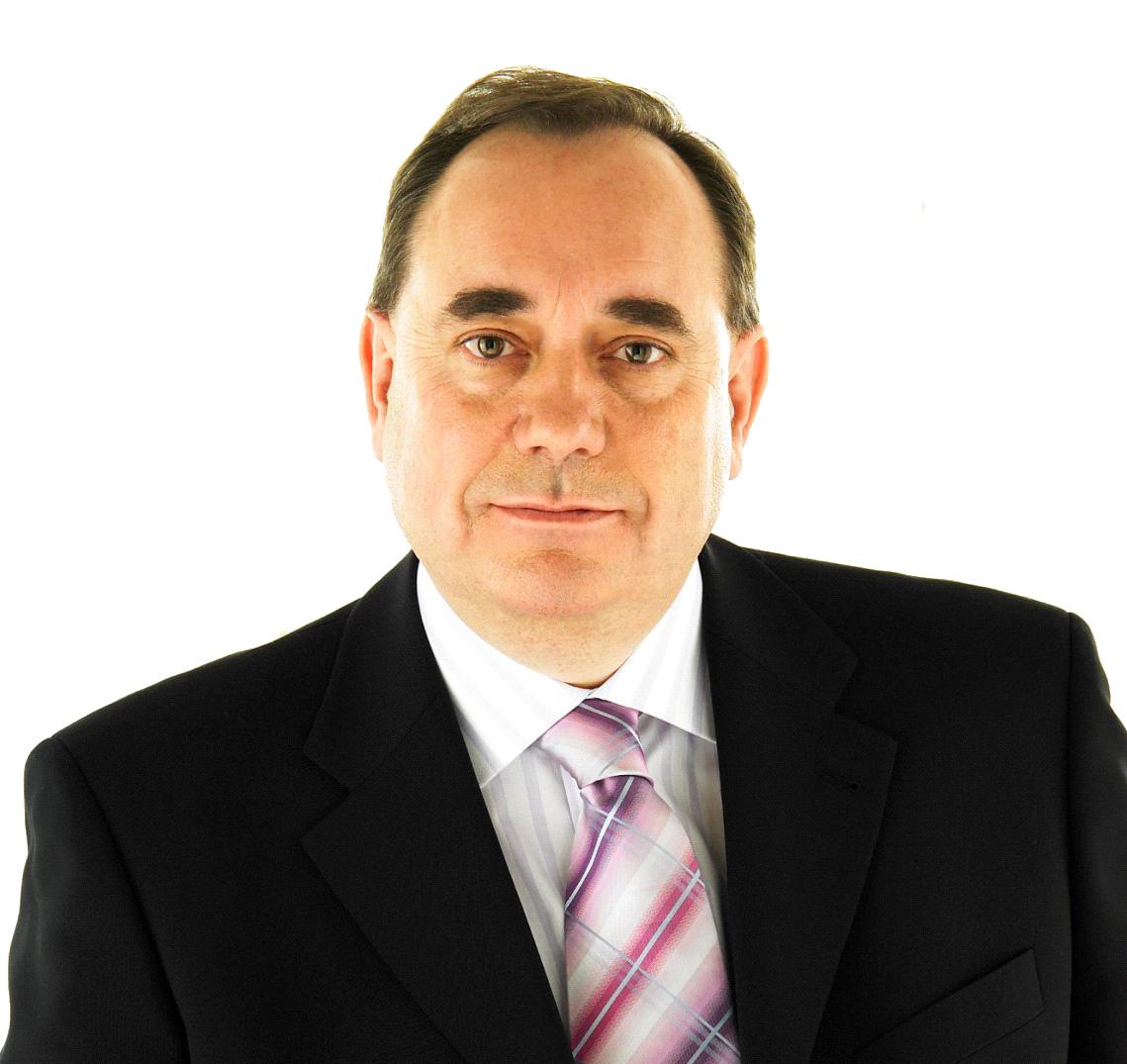
File:Alex Salmond, First Minister of Scotland.jpg
Scottish cabinet.

Although energy is mostly a matter reserved to Westminster, administrative devolution of Sections 36 & 37 of the Electricity Act coupled with fully devolved planning powers enabled the Scottish Government to establish Scotland as a leader in renewable energy developments.

Other recurring campaign themes include nuclear disarmament and Salmond's strong opposition to the 2003 invasion of Iraq. Foreign policy, defence, national security and nuclear weaponry are reserved to Westminster.

Early life and careerSalmond was born at Linlithgow, West Lothian, Scotland on 31 December, (Hogmanay) 1954.[2] He is the second of four children born to Robert Fyfe Findlay Salmond and Mary Stewart Salmond (née Milne), both of whom were Civil Servants.[3] His father's family had been previously resident at Waterfoot, near Keswick.[4][5] His middle names come from his family's tradition of naming their children after the local Church of Scotland minister, in this case the Reverend G. Elliot Anderson of St Ninian's Craigmailen Parish Church in Linlinthgow.[6][7]

Salmond attended the local Linlithgow Academy before studying at the University of St Andrews, where he lived in St Salvator's Hall and graduated with a Joint Honours MA in Economics and History.[8]

In 1978 he entered the Government Economic Service as an Assistant Economist in the Department of Agriculture and Fisheries for Scotland, part of the now defunct Scottish Office. Two years later he joined the Royal Bank of Scotland where he worked for seven years: first as an Assistant Economist before being appointed Oil Economist in 1982, and from 1984 combining that role with duties as a bank economist.[8] While with the Royal Bank, he wrote and broadcast extensively for both domestic and international outlets. He also contributed regularly to oil and energy conferences. In 1983 Salmond created a "Royal Bank/BBC oil index" that is still used.

First Minister

Scottish cabinet.Having won more seats than any other party in the 2007 Scottish Parliament election, the SNP initially approached the Scottish Liberal Democrats to form a coalition, but they declined to take part in negotiations.[23] This left the SNP without any possibility to form a coalition with an overall majority. The Scottish Green Party agreed to support an SNP minority administration on a confidence and supply basis.[24]

Renewable energy

Alex Salmond in his 2010 New Year message highlighted the importance of sustainable development and renewable energy in Scotland and the required increase in powers of the Scottish Parliament needed to help harness Scotland's green energy potential and therefore take full advantage of the "renewable revolution".[35]

Earlier in December 2009, he campaigned for climate change legislation at the UN Climate Change Conference in Copenhagen to promote Scotland's role in tackling and mitigating climate change. This included signing a Partnership Agreement with the Maldives, one of the most exposed countries to the consequences of rising sea levels.[36][37]

This page was last modified on 22 September 2012 at 22:47.

===================================================================

参考リンク

Oyster 800 wave energy converter from the air


aquamarinepowerltdさんが 2011/07/28 にアップロード

This film of the Oyster 800 wave energy converter was shot at the fabrication yard in Methil, Scotland where the device was manufactured. Oyster 800 will be installed at sea in Orkney in summer 2011. The footage was shot by Cyberhawk Innovations.

===================================================================

参考リンク

New Oyster wave device


scottishgovernmentさんが 2011/07/14 にアップロード

Wave energy developer Aquamarine Power today revealed the latest in leading edge hydro electric wave energy technology.

===================================================================

===================================================================

参考リンク

European Marine Energy Centre (EMEC) http://www.emec.org.uk/

===================================================================

参考リンク

ANDRITZ HYDRO Hammerfest Tidal current device


http://www.emec.org.uk/about-us/our-tidal-clients/andritz-hydro-hammerfest/

You are here: Home / About us / Tidal clients / ANDRITZ HYDRO Hammerfest

ANDRITZ HYDRO Hammerfest

ANDRITZ HYDRO Hammerfest delivers tidal turbine arrays and services to harness the great energy potential from tidal streams. The modular solutions are designed to allow optimal integration in the daily operation plans of the customers, supporting the worldwide energy mix.

The Company was established in 1997 in Hammerfest, Norway and the UK office was opened in Glasgow in 2008 in order to serve the promising local market potential. Today, ANDRITZ HYDRO Hammerfest is part of the ANDRITZ HYDRO GmbH group, a global supplier of electro-mechanical equipment and services for the hydropower business.

In December 2011, ANDRITZ HYDRO Hammerfest successfully deployed its 1 megawatt (MW) pre-commercial tidal turbine destined to validate the technology for future tidal power arrays. The machine was installed at the European Marine Energy Centre (EMEC) in December 2011 and delivered its first energy to the grid in February 2012.

The new HS1000 turbine is based on the technology of a smaller turbine, the HS300, which was installed in Norway as the first ever tidal current turbine with permanent connection to the public grid in 2004. The prototype has been in operation for more than 17,000 hours, delivering over 1.5 GWh to the grid and showed 98% availability during testing.

For more information, please visit the homepage of ANDRITZ HYDRO Hammerfest:

www.hammerfeststrom.com, www.andritz.com http://www.andritz.com/hydro.htm

Andritz Hydro Hammerfest.mp4


Copyright © 2012 · All Rights Reserved · EMEC: European Marine Energy Centre

===================================================================

参考リンク Global Tidal Energy Part 1


RedOrkneyさんが 2010/11/30 にアップロード

Scotland is now at the epicenter of the Global tidal power renewable energy revolution.

( Filmed and edited by Kevin Burns)

This video highlights the global potential of tidal energy, Scotland's leading role in tidal power development and reviews some of the technical, environmental and social challenges facing the tidal power developers.

For further details, please visit,

http://www.hammerfeststrom.com/

http://www.atlantisresourcescorporation.com/

http://www.emec.org.uk/index.asp

http://www.openhydro.com/home.html

http://www.thecrownestate.co.uk/

http://www.scotland.gov.uk/Home

http://www.scotland.gov.uk/About/Directorates/Wealthier-and-Fairer/marine-sco...

http://www.sserenewables.com/what-we-do/marine/

http://www.icit.hw.ac.uk/

Global Tidal Energy Part2


===================================================================

参考リンク

Wave devices

You are here: Home / Marine Energy / Wave devices

http://www.emec.org.uk/marine-energy/wave-devices/

Waves have the potential to provide a completely sustainable source of energy, which can be captured and converted into electricity by wave energy converter (WEC) machines. These WECs have been developed to extract energy from shoreline out to the deeper waters offshore.

We have identified eight main types of WEC:

Copyright © 2012 · All Rights Reserved · EMEC: European Marine Energy Centre

===================================================================

参考リンク Tidal devices

http://www.emec.org.uk/marine-energy/tidal-devices/

You are here: Home / Marine Energy / Tidal devices

Tidal devices

Tidal energy exploits the natural ebb and flow of coastal tidal waters caused principally by the interaction of the gravitational fields of the earth, moon and sun. The fast sea currents are often magnified by topographical features, such as headlands, inlets and straits, or by the shape of the seabed when water is forced through narrow channels. The tidal stream devices, which utilise these currents, are broadly similar to submerged wind turbines and are used to exploit the kinetic energy in tidal currents. Due to the higher density of water, this means that the blades can be smaller and turn more slowly, but they still deliver a significant amount of power. To increase the flow and power output from the turbine, concentrators (or shrouds) may be used around the blades to streamline and concentrate the flow towards the rotors.

We have identified six main types of Tidal Energy Convertors (TEC):

Copyright © 2012 · All Rights Reserved · EMEC: European Marine Energy Centre

====================================================================

http://www.aquamarinepower.com/news/pentland-firth-and-orkney-wave-and-tidal-charges-hit-£100-million/

NEWS

Pentland Firth and Orkney wave and tidal charges hit £100 million 18 Sep 12

New figures from Scottish Renewables have shown that island communities in Scotland's first Marine Energy Park are continuing to face massive costs to connect their marine energy projects to the grid.

Analysis, published at today's Marine Energy Conference in Inverness, reveals charges in the Pentland Firth and Orkney Waters have continued to climb, despite an independent review by Ofgem to reform the charging regime known as TNUoS (Transmission Network Use of System).

Although the review has improved matters for generators on the mainland, charges on the islands are set to rocket, adding significant costs and threatening the economic viability of wave and tidal projects that are in their early stages of development.

Speaking ahead of the Marine Energy Conference, Niall Stuart, Chief Executive of Scottish Renewables, said:

"Ofgem's review was expected to bring down charges for renewable generation given its commitment to 'facilitate the move to a low carbon energy sector'. However, we are seeing charges on the islands continue to increase, dwarfing those on the mainland.

"The level of charges for Orkney Waters is adding significant costs to wave and tidal projects and can only hold back investment in our world-leading marine energy sector."

We have to remember that our islands are where some of our best natural resources are and if we are to meet important climate change and renewable energy targets we must find a way to ensure wind, wave and tidal projects can generate electricity for homes and businesses across Scotland."

The new figures are estimated calculations based on annual grid charges for wave and tidal projects. Estimates of the projected annual connection charges for the Pentland Firth and Orkney Waters area have increased from £56m last year to £107m in 2020. This contrasts with an annual subsidy of some £2m if these projects were to be built in the south west of England - the UK's other Marine Energy Park.

While the mainland of Pentland Firth has seen a decrease of £4.6m in annual connection charges, the Orkney Waters area has seen a massive rise because electricity generators on the islands are required to pay for 'local works' which includes expensive undersea grid cabling from the Scottish mainland to the Orkney islands.

This year's estimates are also based on a larger grid cable which will be required to transport the increasing capacity of renewable electricity due to be generated in the Orkney waters from wave and tidal devices.

Aquamarine Power Chief Executive Officer Martin McAdam said:

"These new figures clearly show the methodologies employed by Ofgem and National Grid are out of step with the needs of the UK's renewable energy sector.

"With a quarter of the UK's generating capacity shutting down over the next ten years and domestic gas bills increasing 78 per cent since 2000, more than ever the UK needs a diverse renewable energy mix to secure future energy independence and to act as a hedge against fossil fuel price volatility.

"Wave energy can be a valuable part of that mix, but wave projects have to locate where the waves are - and 92 per cent of all UK wave energy projects will be subject to islands charging.

"We believe island charges are contrary to EC Directive 2009/28, Article 16(4) which states 'Member States shall ensure the charging of transmission tariffs does not discriminate against electricity from renewable energy sources produced in peripheral regions, such as island regions…'.

"The Secretary of State for Energy and Climate Change Ed Davey should step in with new measures to ensure islands charges do not jeopardise the UK's world-leading wave and tidal industry."

© Aquamarine Power 2011
All rights reserved

====================================================================

Tsunami Strike: Japan Part III: Warning Systems

Tsunami Strike: Japan Part III: Warning Systems


Transcript Tsunami Strike: Japan Part III – Warning Systems [Sirens] These are the sounds of a tsunami warning. They alert residents that a killer wave is about to strike. These sirens, however, are just a small part of the sophisticated warning systems that played a role in Japan and in the U.S. during the Pacific Ocean tsunami in March 2011. Most Tsunamis are generated by an undersea earthquake. Fortunately, Japan has one of the most advanced earthquake early-warning systems in the world. It detects tremors, calculates the epicenter, and sends out warnings from over a thousand seismographs scattered throughout the country. The Japan Meteorological Agency issues the warnings and sends alerts to television and radio channels, the internet, and mobile phone networks. When the earthquake struck 80 miles offshore, warnings were generated in about three seconds. The tsunami warnings came three minutes later. These take longer because more complex calculations are involved, and must factor in ocean data. Since the first tsunami waves struck the coastline within 20 minutes, the advance warning provided some residents with crucial minutes to reach a safe area. While the earthquake sent powerful tsunami waves westward toward Japan, the tsunami also propagated east into the Pacific Ocean. Here, warnings are issued by the Pacific Tsunami Warning Center, operated by NOAA in Hawaii. NOAA maintains a large network of buoys with ocean floor sensors that are strategically positioned in the earthquake-prone zones of the Pacific. This system collects vital ocean data for tsunami forecasting. Narrator: On March 11th, only 25 minutes after the earthquake struck, the first buoy station registered the tsunami and relayed information to Hawaii. Scientists used this data to run models and issue forecasts and warnings to nations throughout the Pacific. From there, local emergency managers decided what actions were appropriate to take for public safety. The earthquake and resulting tsunami devastated the Japanese coastline, causing damage that will take years to repair. While we can't prevent these forces of nature from happening, our early warning systems can help us prepare for the dangers headed our way. END

Translate